Key Takeaways
-
Low refrigerant almost always indicates a leak in the sealed A/C system; DIY recharge cans only provide temporary relief and waste money without fixing the underlying problem.
-
Match symptoms to causes: warm air with strong airflow suggests low refrigerant or compressor issues, while weak airflow points to a dirty cabin filter or failed blower motor.
-
Delaying A/C repairs allows small leaks to starve the compressor of oil, causing catastrophic failure and turning affordable fixes into expensive system replacements.
-
Professional A/C service requires proper leak detection, recovery equipment, and EPA Section 609 certification; refrigerant types (R-134a vs R-1234yf) must never be mixed or overcharged.
-
Perform quick home checks first: inspect cabin air filter, check condenser for debris, listen for compressor clutch engagement, and verify fuse/relay condition before calling a technician.
-
If A/C blows cold while driving but turns warm at idle, the condenser fan likely failed or the condenser is clogged with dirt; cleaning or fan replacement usually resolves this issue.
Few things feel worse than climbing into a hot car, cranking the A/C, and getting a blast of warm, sticky air. If you have ever asked yourself, “why is my car AC not working?” you are in good company. It happens to almost every driver at some point, and it always seems to happen on the hottest day of the year.
Here is the good news. Most car A/C problems come down to a short list of causes. Once you know what to look for, you can describe the problem clearly, avoid costly guesswork, and get the right fix the first time.
In this guide, we will walk through the three biggest mistakes drivers make when their A/C quits. We will also cover the symptoms that point to each cause, quick checks you can do at home, and when it is time to call a pro. Whether you drive a daily commuter, a work truck, a bus, or an RV, these tips apply to you. Let’s get your cool air back.
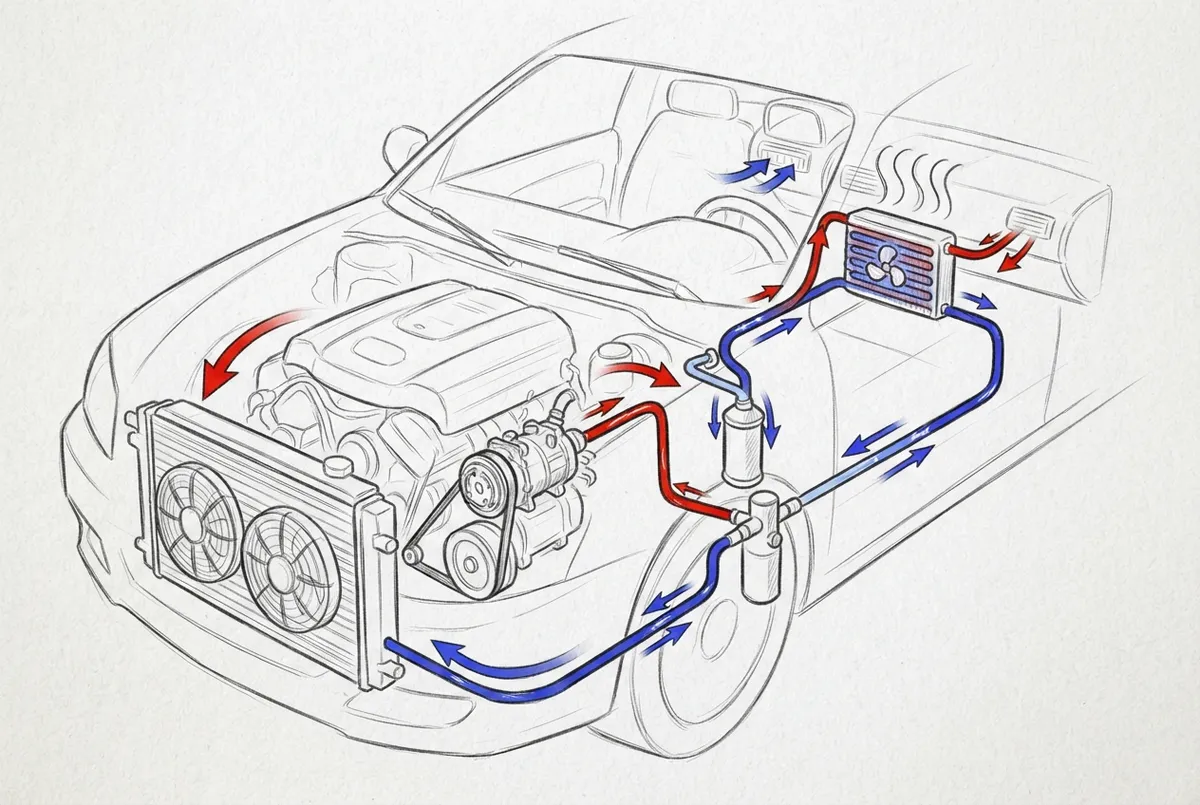
How Your Car A/C Actually Works
Before we dive into the mistakes, it helps to know the basics. Your car’s A/C is a sealed loop filled with refrigerant. A compressor pushes the refrigerant through the system. The condenser (that radiator-looking part at the front of the car) releases heat. Then the evaporator inside the dash chills the air that blows into your cabin.
Because the loop is sealed, refrigerant should not just disappear. If the level is low, there is almost always a leak somewhere. That one fact explains a lot of the trouble drivers run into.
Here are the main parts that can cause your A/C to stop cooling:
- Compressor: The heart of the system. It circulates refrigerant under pressure.
- Condenser and fan: They shed heat. If airflow is poor, cooling drops.
- Evaporator: The cold coil that cools the air inside your cabin.
- Blower motor and cabin air filter: They move air through your vents.
- Fuses, relays, sensors, and wiring: They tell the system when to turn on and off.
Want a closer look at the parts that matter most? Our guide to 6 A/C parts every vehicle owner should know in 2026 breaks them down in plain English.
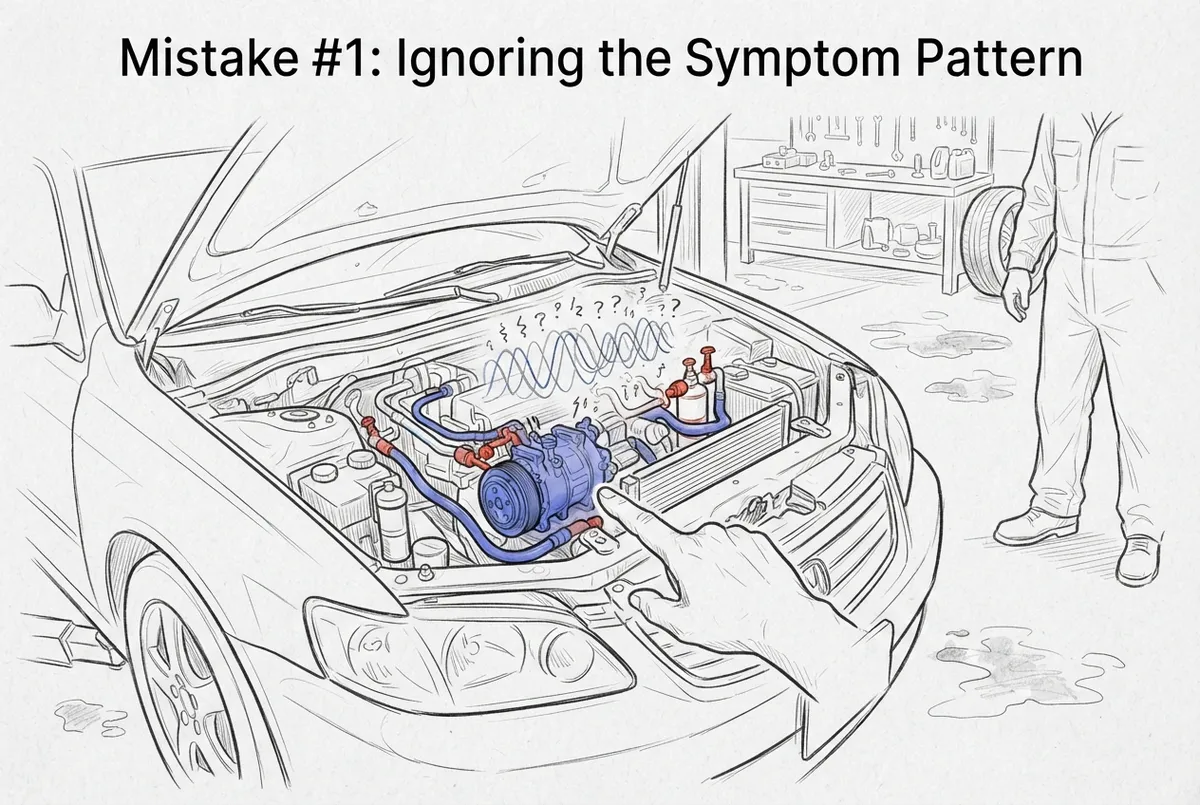
Mistake #1: Ignoring the Symptom Pattern
The first mistake is treating every A/C problem the same way. Your car is actually giving you clues. The way it fails tells you a lot about what is wrong. Paying attention to these clues can save you time and money.
Warm Air With Strong Airflow
If the air is blowing hard but it is not cold, the blower is doing its job. The cooling part of the system is not. Likely causes include low refrigerant from a leak, a compressor that is not engaging, a blocked condenser, a failed condenser fan, or a restriction somewhere in the system.
If this sounds like your car, take a look at our post on 10 reasons your AC is blowing warm air for more detail.
Weak Airflow or No Air at All
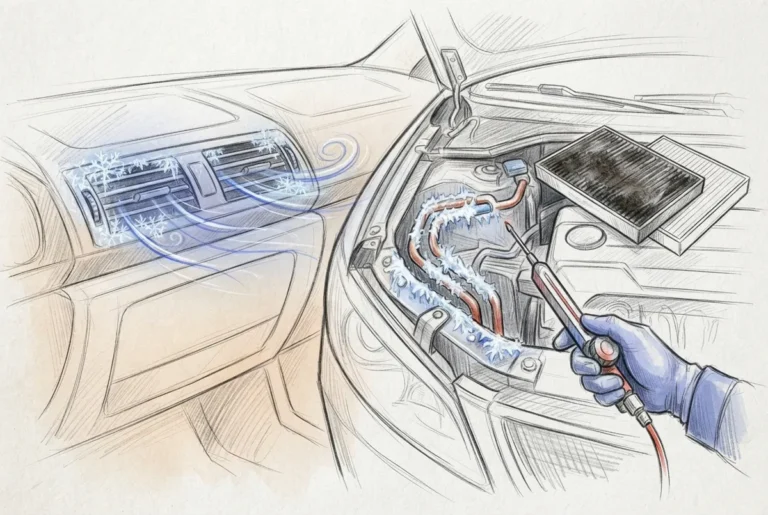
If very little air comes out of the vents, even on high, the refrigeration side might be fine. The problem could be a clogged cabin air filter, a weak or dead blower motor, a bad blower resistor, or a stuck air-distribution door inside the dash. A dirty filter is the easiest thing to check and one of the cheapest to fix.
Cool at Highway Speed, Warm at Idle
This one is a classic. If your A/C blows cold while you drive but turns warm in traffic or at a red light, the condenser probably is not getting enough airflow. A failed condenser fan or a condenser clogged with bugs, dirt, or road debris is a common culprit. In Tampa’s heat and stop-and-go traffic, this problem shows up fast.
Quick Symptom Guide
| What You Notice | Likely Cause | What to Do |
|---|---|---|
| Warm air, strong airflow | Low refrigerant, compressor issue, blocked condenser | Get a pressure check and leak test |
| Weak or no airflow | Dirty cabin filter, bad blower motor, stuck door | Check filter first, then test blower |
| Cold on the road, warm at idle | Failed condenser fan, dirty condenser | Inspect fan and clean condenser |
| Cool, then suddenly warm | Compressor clutch, relay, or pressure switch | Have electrical controls tested |
| Unusual noise when A/C is on | Worn compressor or loose belt | Turn A/C off and schedule a diagnosis |
Jot down what you notice before you call a shop. Little details, like “it only gets warm at idle,” help a technician zero in on the problem faster.
Mistake #2: Reaching for a DIY Recharge Can
The second mistake is the most common one. When the air stops being cold, many drivers grab a recharge can from the auto parts store. It feels like a cheap, fast fix. Sometimes it even works for a little while. But there are some big problems with this approach.
Low Refrigerant Means a Leak
Remember, your A/C is a sealed system. If refrigerant is low, it has leaked out. Adding more refrigerant might bring back cold air for a few days or weeks, but it does not fix the leak. The new refrigerant just escapes too. You end up spending more money over time and the real problem keeps getting worse.
We see this a lot, and we explain the costly pattern in 13 AC leak mistakes that cost car owners more money. If you want to catch a problem early, our guide on how to detect A/C leaks in your truck is a helpful read, and it applies to cars too.
Overcharging and Mixed Refrigerants
Too much refrigerant is just as bad as too little. Overcharging can raise pressure, strain the compressor, and even cause a failure. Most cans do not measure the charge by weight, which is how your vehicle maker specifies it. Also, vehicles use different refrigerants, commonly R-134a or R-1234yf depending on the model and year. The type and charge amount are listed on a label under the hood. These refrigerants should never be mixed.
Curious about the newer refrigerant? Read our breakdown of 12 things to know about R-134a to 1234yf conversion.
The Legal Side of Refrigerant
Refrigerant is regulated for a reason. According to the U.S. EPA, R-134a has a global warming potential about 1,400 times that of CO₂. Because of this, the EPA requires that paid service involving refrigerant be done by Section 609-certified technicians using approved recovery equipment. Venting refrigerant on purpose is prohibited. It must be recovered and recycled or reclaimed.
That is one more reason to let a certified pro handle refrigerant work. At Marks Air, we also offer training on this topic, including EPA 609 certification and HFO-1234yf training, so technicians stay current. If you want to avoid common training pitfalls, check out 13 EPA 609 certification training mistakes to avoid.
A Better Approach
A proper professional repair usually follows these steps:
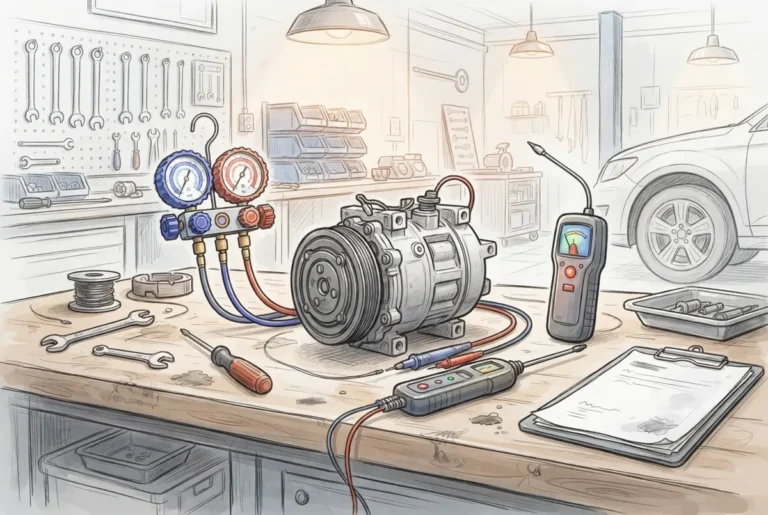
- Check system operation and pressures to see how the A/C is performing.
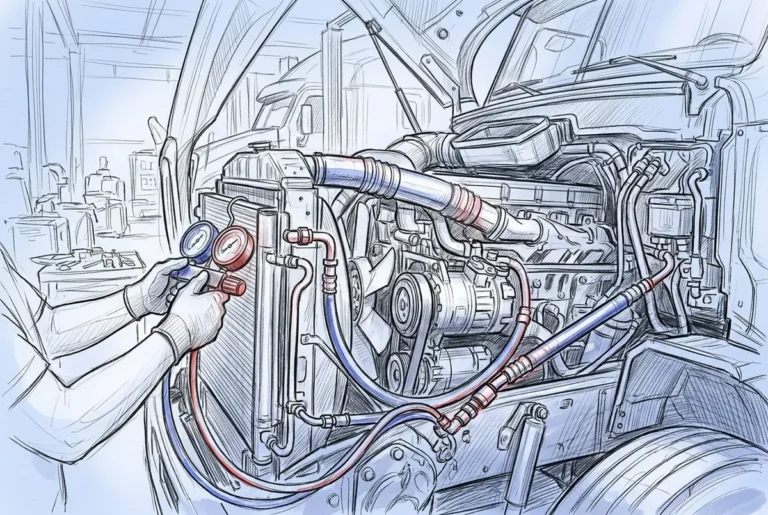
- Find the leak using an electronic detector or approved UV dye.
- Repair or replace the failed part, such as a hose, seal, condenser, or compressor.
- Recover any remaining refrigerant with approved equipment.
- Evacuate the system to remove air and moisture.
- Recharge to the exact amount the vehicle maker specifies, measured by weight.
This is how you fix the cause instead of covering it up. If you are wondering what this costs, our post on how much auto A/C repair costs gives you a realistic picture.
Mistake #3: Waiting Too Long to Get It Checked
The third mistake is the quiet one. Many drivers put up with a weak A/C for weeks or even months. They roll the windows down, tell themselves it will be fine, and hope the problem goes away. It rarely does.
Small Problems Grow Into Big Bills
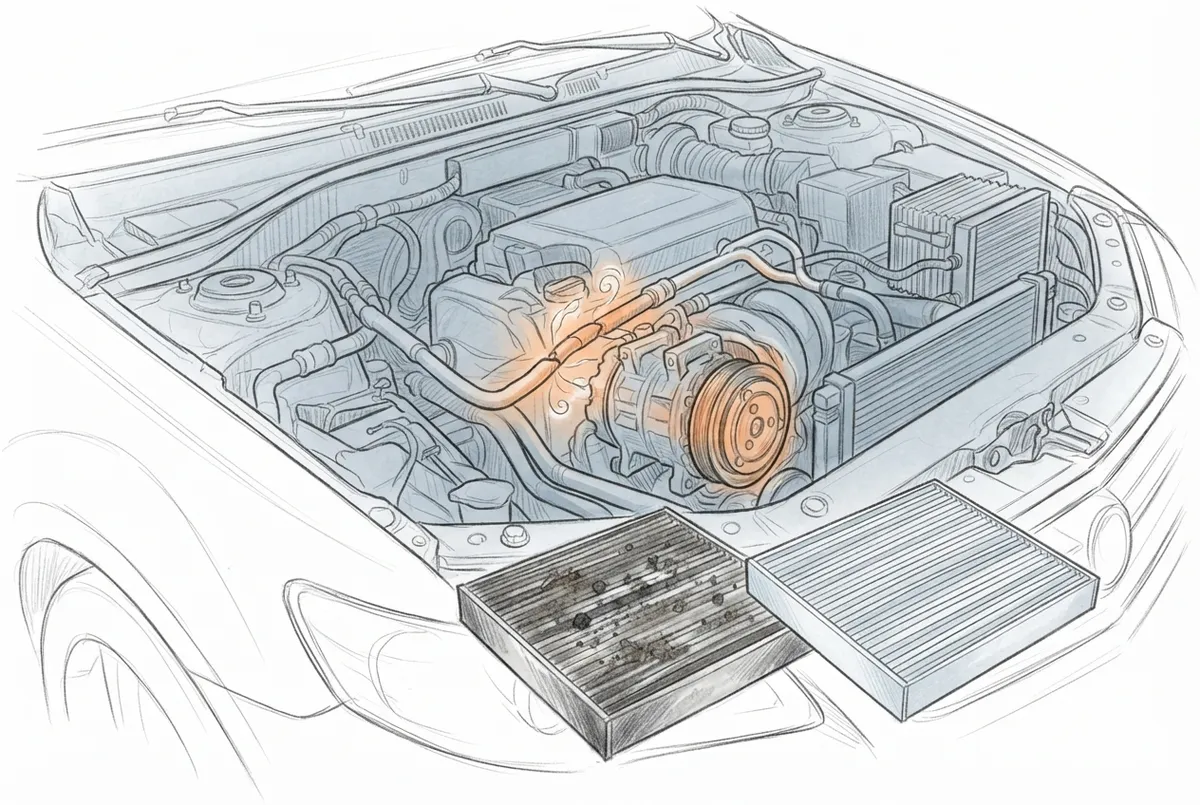
A small leak or a failing fan is often an affordable fix. But if the system runs low on refrigerant, the compressor can lose the oil it needs to stay lubricated. A starved compressor can fail, and a failed compressor can send metal debris through the whole system. That turns a modest repair into a big one.
If you are already facing that situation, our guide on how to fix an AC compressor in your vehicle and our breakdown of repair versus replace for your A/C compressor can help you decide your next step.
Warning Signs You Should Not Ignore
Watch for these red flags. They mean it is time to book a diagnosis:
- Air that is only slightly cool, even on the coldest setting
- Grinding, squealing, or rattling noises when the A/C turns on
- A musty or chemical smell from the vents
- Water pooling inside the cabin or an oily residue near A/C lines
- An A/C clutch that clicks on and off rapidly
- Cooling that fades slowly over weeks
If one of these sounds familiar, our 5 signs you need car A/C repair guide for 2026 can help you decide how urgent it is.
Why Tampa Drivers Can’t Afford to Wait
Heat and humidity are tough on A/C systems. In Florida, you are running your A/C nearly year-round, which means more wear on every part. A weak system in a Tampa summer is not just uncomfortable. It can be a safety issue, especially for kids, pets, older passengers, and drivers who spend long hours behind the wheel. Learn more about why this matters in why A/C repair in Tampa is so important for your vehicle.
Quick Checks You Can Do Before Calling a Shop
Not everything needs a technician right away. Here are a few simple checks you can do in your driveway. They will not fix every problem, but they can rule out the easy stuff.
- Turn the fan up and feel the airflow. If it is weak, check the cabin air filter next.
- Replace a dirty cabin air filter. A clogged filter can choke airflow even when the cooling system works fine.
- Look at the condenser through the grille. If you see bugs, leaves, or bent fins, airflow may be blocked.
- Check that the condenser fan runs. With the A/C on and the engine warm, the fan should spin.
- Listen for the compressor clutch. You should hear a click when the A/C turns on.
- Check the fuse and relay. Your owner’s manual shows where they are. A blown fuse is a cheap fix.
Safety first. Keep your hands, hair, and clothing away from belts and fans when the engine is running. If you are not sure about something, stop and ask a professional.
Not Just Cars: Trucks, Buses, RVs, and Heavy Equipment
The causes are similar across different vehicles, but the stakes can be higher. A truck driver on a long haul needs reliable cooling for safety and comfort. A bus operator needs consistent A/C for passengers. An RV owner wants a cool camper at the end of a long drive. A heavy equipment operator can lose focus and energy without a working cab A/C.
Fleet owners especially feel the cost of downtime. If you manage multiple vehicles, take a look at 4 fleet vehicle A/C repair tips that save you money and preventive versus reactive fleet A/C maintenance. For commercial vehicles, you may also want to learn about the most important commercial vehicle A/C parts.
When to Call a Professional
You should call a pro when any of these happen:
- The A/C is blowing warm air and you suspect a leak
- You hear grinding or squealing from the compressor
- You have tried the basic checks and nothing changed
- Your vehicle uses R-1234yf, which requires special equipment
- You are not sure what is wrong and do not want to guess
A good shop will explain what they find, show you the problem, and give you clear options. Not sure how to pick one? Our guide to how to find reliable auto A/C service in Tampa Bay walks you through it. You can also see what other drivers say on our reviews page, or see what our Marks Air customers say on Google.
Why Drivers Trust Marks Air
Marks Air is a family-owned, woman-owned business that has focused on vehicle air conditioning in Tampa since 1971. That is more than five decades of experience on cars, trucks, buses, RVs, emergency vehicles, and heavy equipment. We are proud to be a member of the Mobile Air Climate Systems Association (MACS), which keeps us aligned with current industry standards.
Our shop handles full A/C diagnostics, leak detection, repairs, and installations, and we stock a full line of A/C parts, many available the same day. Because we only do A/C, we know these systems inside and out. Want to know more about us? Visit our About Marks Air page or find us on Facebook.
Final Thoughts: Cool Air Is Closer Than You Think
If you have been wondering, “why is my car AC not working?”, the answer is usually one of a few things: a leak, an airflow problem, or an electrical or compressor fault. The key is to read the symptoms, skip the quick-fix recharge can, and not wait until a small issue becomes a big one.
You do not have to figure it out alone. Our team is here to find the real cause and fix it right, so you can get back on the road in comfort. Schedule service with Marks Air today, or call us at 813-988-1671 to talk with a friendly A/C expert. Bring your vehicle to our Tampa shop, and let’s get that cold air blowing again.
FAQs
Q: Why is my car A/C blowing warm air?
A: The most common reason is low refrigerant from a leak, but a failing compressor, a blocked condenser, or a bad condenser fan can also cause it. A quick pressure check and leak test will tell a technician which one it is. Don’t worry, it’s usually a fixable problem!
Q: Does low refrigerant mean my car A/C has a leak?
A: Yes, almost always. A car A/C is a sealed system, so refrigerant should not run low on its own. Topping it off may bring cold air back for a short time, but the leak will keep draining it until it’s properly repaired.
Q: Can I recharge my car A/C myself?
A: You can buy DIY cans, but it’s not the best idea. They don’t fix the leak, can overcharge the system, and may use the wrong refrigerant type. In the U.S., paid refrigerant service also requires a Section 609-certified technician, so a pro is the safer choice.
Q: How do mechanics find a leak in a car A/C system?
A: Technicians usually use an electronic leak detector or approved UV dye to pinpoint where refrigerant is escaping. Once they find the leak, they repair or replace the part, recover the old refrigerant, and recharge the system to the maker’s exact specification.
Q: Why does my car A/C work while driving but not at idle?
A: This usually points to poor airflow across the condenser. A failed condenser fan or a condenser clogged with dirt and debris can’t shed heat when the car is stopped. At highway speed, the moving air helps, which is why cooling improves while you drive.