Key Takeaways
-
Low refrigerant almost always means a leak, not normal usage, so topping off with a recharge can waste money and won't fix the real problem.
-
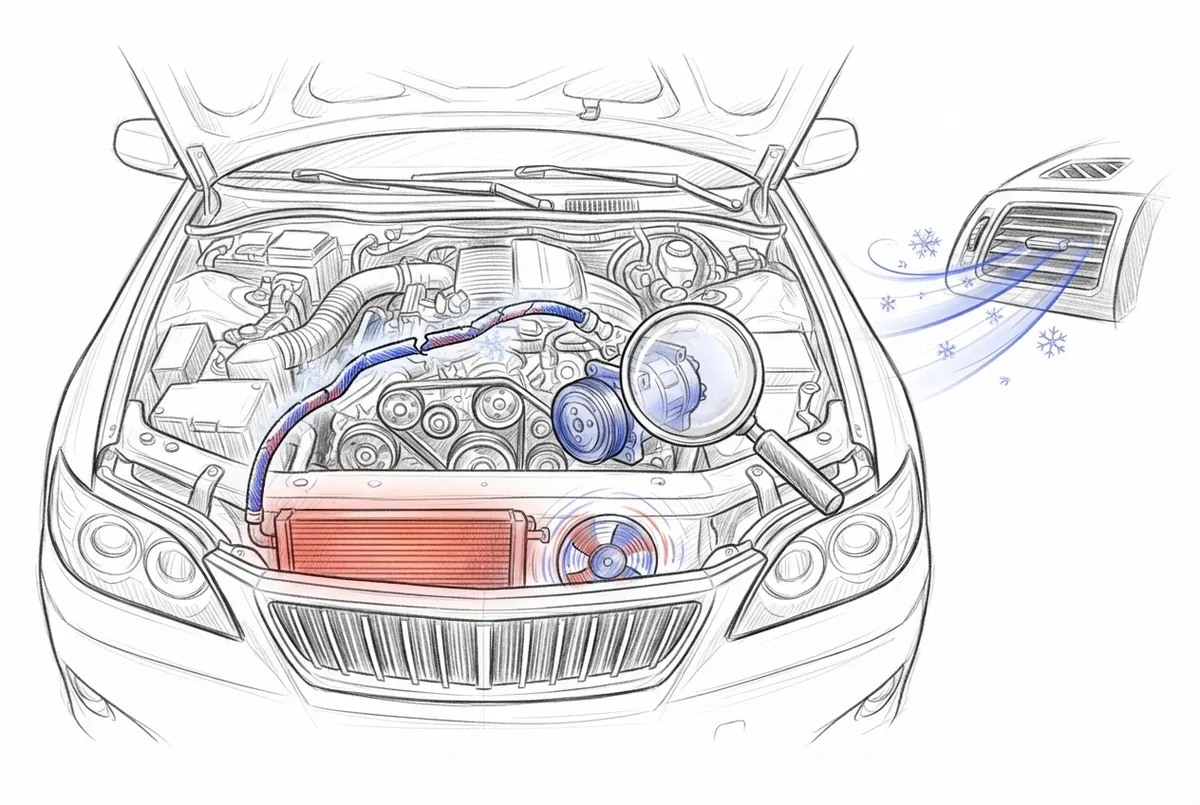
If your A/C cools on the highway but turns warm at idle, suspect weak condenser airflow from a failed cooling fan or a clogged condenser.
-
A compressor that won't engage may be caused by a blown fuse, bad relay, or faulty pressure sensor rather than a dead compressor, so check electrical parts first.
-
Cold air on one side of the car and warm air on the other usually points to a stuck blend door or failing actuator inside the dash.
-
Quick DIY checks like listening for the compressor clutch click, inspecting the condenser for debris, and confirming the fan runs can give your technician a useful head start.
-
In the U.S., paid refrigerant service must be done by EPA Section 609-certified technicians using approved recovery equipment, and venting refrigerant is prohibited.
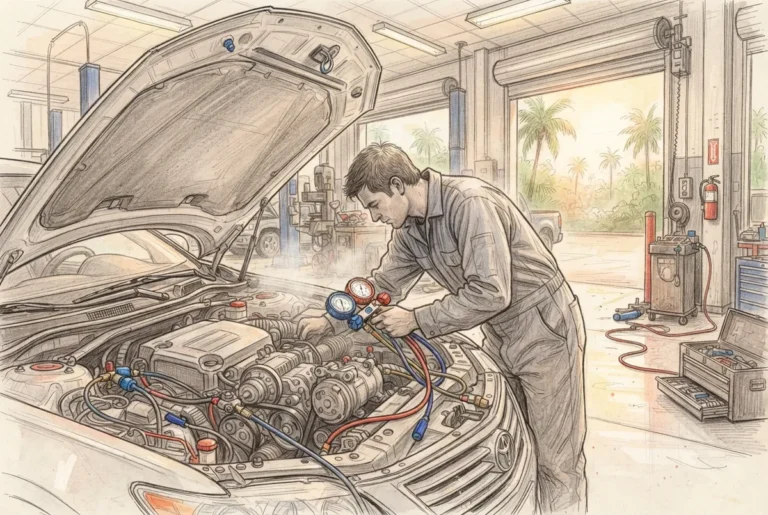
It is a hot Tampa afternoon. You hop in the car, crank the A/C, and out comes warm, sticky air. We have all been there, and it is never fun! If you have wondered what causes car ac to stop cooling, you are in good company. The good news is that the cause is usually one of a handful of common problems, and knowing them can save you time, sweat, and money.
Whether you drive a daily commuter, haul freight, run a bus route, or camp in an RV, the basics are the same. Your A/C is a sealed system that moves heat out of the cabin. When one part slips, the whole system can stop cooling. Below, we walk through eight common culprits, what they feel like, and what a good shop does to fix them. We also share when to call a pro. For a quick read on related symptoms, see 10 Reasons Your AC Is Blowing Warm Air (And How to Fix It).
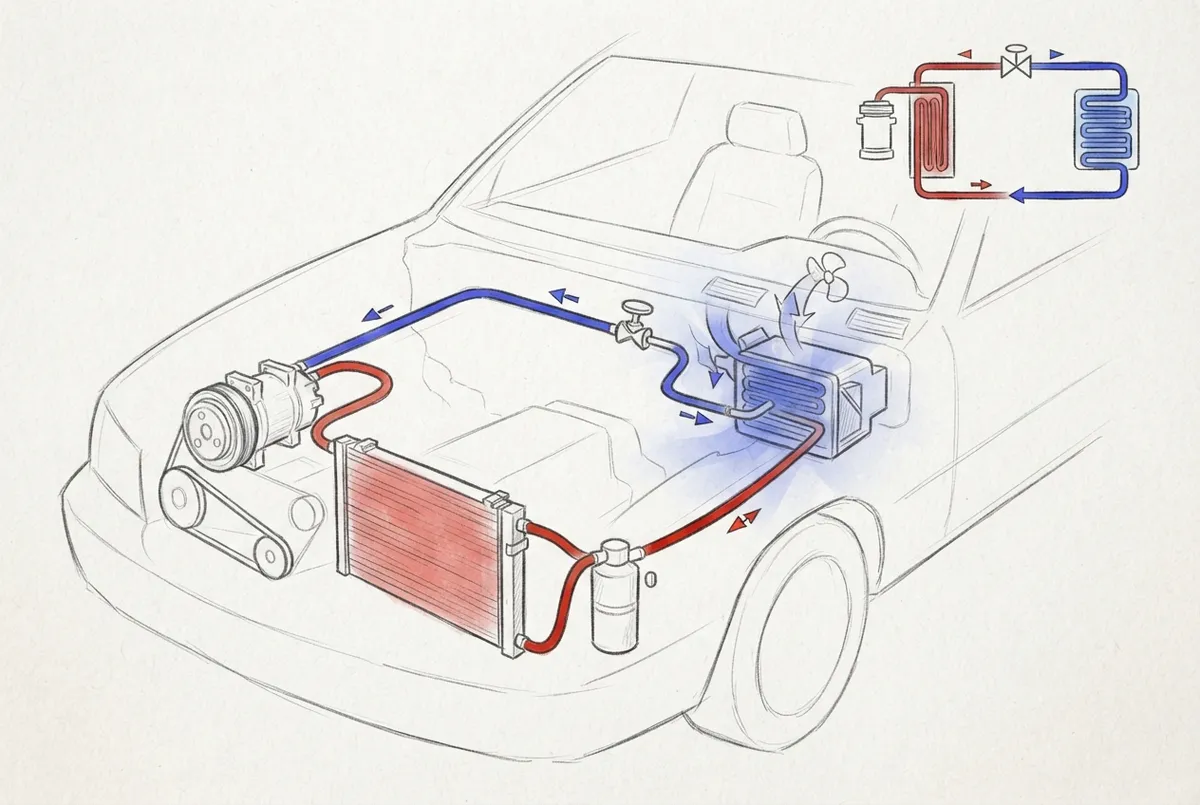
How a Car A/C System Works (The Quick Version)
Before we dive in, a short refresher helps. Your A/C does not make cold air. It moves heat. The compressor pushes refrigerant through the system. The condenser releases heat outside the car. The expansion valve or orifice tube meters the refrigerant. The evaporator then soaks up heat from the cabin air. A blower pushes that cooled air through your vents.
If any link in that chain breaks, cooling suffers. That is why symptoms can look alike even when the causes are very different. A weak vent and a warm vent can both feel like “my A/C is broken,” but they point to different parts.
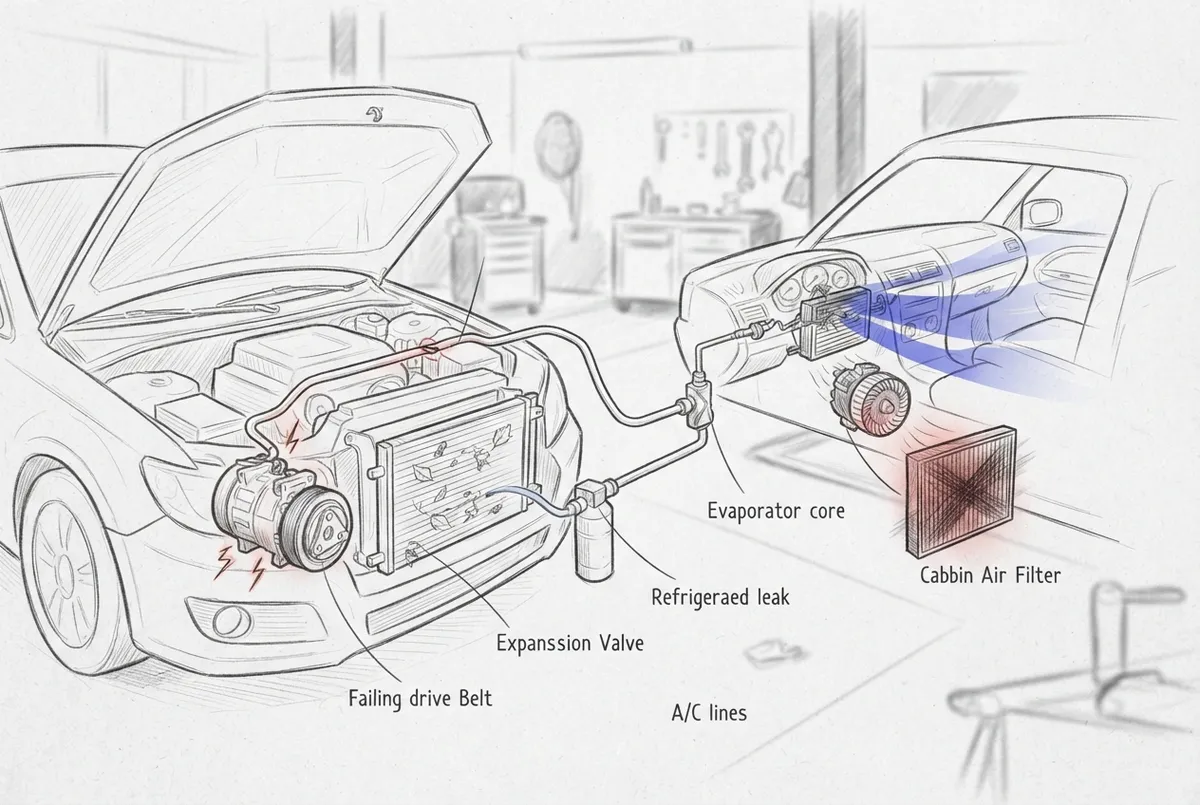
8 Reasons Your Car A/C Stops Cooling
1. Low Refrigerant From a Leak
Low refrigerant is one of the most frequent reasons a car A/C stops cooling. Here is the key point: refrigerant is not “used up” like gas. A sealed A/C system should hold its charge. If it is low, there is almost always a leak somewhere.
Leaks can show up at O-rings and service ports, hoses or crimps, the condenser, compressor seals, or the evaporator. Some are easy to spot as oily residue. Others hide inside the dash. Shops can use approved leak-detection methods to find them. To learn more, read Why Won’t Your Car A/C Stop Losing Refrigerant?
Common signs of a leak include:
- Air that is cool at first, then slowly turns warm
- Oily, greasy spots on A/C lines or fittings
- A compressor that cycles on and off quickly
- A system that needs “just a little” recharge every few months
2. Poor Airflow Across the Condenser
The condenser sits at the front of the vehicle, usually near the radiator. It must shed heat to the outside air. If airflow is weak, cooling drops, especially at idle or in hot weather. That is why many drivers say the A/C works on the highway but gets warm in traffic.
Possible causes include a failed cooling fan, bent or blocked condenser fins, or debris stuck in front of the core. Leaves, bugs, and road grime build up over time. A condenser that is damaged can also leak. If this sounds familiar, our guide on 10 Signs You Need AC Condenser Repair in Tampa (2026) can help you sort it out.
3. A Compressor That Is Not Working
The compressor is the heart of the system. If it does not run, or cannot build pressure, you will not get cold air. A failing compressor may make grinding or squealing noises. It may also fail to engage at all.
Causes include compressor or clutch failure, a worn belt, electrical or control faults, or a pressure sensor that shuts the system down to protect it. Sometimes the compressor is fine, and the real issue is a blown fuse or a bad relay. That is why diagnosis matters. Dig deeper in How to Fix an AC Compressor in Your Vehicle.
4. A Restricted Expansion Valve or Orifice Tube
This small part controls how much refrigerant enters the evaporator. When it clogs with debris or moisture, refrigerant cannot flow the way it should. The result can be weak cooling, frosty lines, or pressure readings that do not look right.
This problem often follows a failed compressor, since tiny metal bits can travel through the system. A good repair includes more than swapping one part. The shop should flush or replace parts as needed so the new components are not damaged right away.
5. Electrical and Control Problems
Modern A/C systems rely on switches, sensors, relays, and control modules. A single bad sensor can tell the compressor to stay off. A blown fuse or worn relay can do the same thing. These faults can be tricky because the A/C parts may be perfectly healthy.
Warning signs include an A/C button that lights up but nothing happens, or a system that works one day and not the next. Intermittent trouble is a classic clue to an electrical issue. A trained technician can check circuits and controls before replacing expensive parts.
6. A Clogged Cabin Air Filter or Weak Blower
Sometimes the air is cold, but you just cannot feel it. A dirty cabin air filter can choke airflow. A weak or failing blower motor can do the same. You may notice strong cold air at the highest fan setting only, or very little air at any setting.
This is one of the easier problems to fix, and a good first check. If your truck has a tired blower, take a look at 6 Truck AC Blower Motor Repair Fixes That Actually Work.
7. A Faulty Blend Door
Inside the dash, a small door mixes heated air with cooled air. If it sticks or the actuator fails, hot air can sneak into the mix. You might feel cold air on one side of the car and warm air on the other. You may also hear clicking behind the dash.
Because the system itself may be working fine, this can fool people into thinking they need a recharge. A shop can test the actuator and the door to confirm. It is a great example of why guessing can get expensive.
8. A Frozen or Failing Evaporator
The evaporator sits behind the dash and cools the air that reaches you. If it ices up, airflow gets blocked and cooling drops. If it leaks, refrigerant escapes and you lose cooling for good. Evaporator work can be labor heavy since the dash may need to come apart.
Read more in AC Evaporator Coil Repair: What Vehicle Owners Should Know, or learn what can cause icing in What Causes AC Coils to Freeze in Your Vehicle?
Quick Symptom Guide: What Might Be Going On
Use this table as a starting point. It is not a diagnosis, but it can help you describe the problem when you call a shop.
| What You Notice | Likely Cause | Next Step |
|---|---|---|
| Warm air, gets worse over time | Low refrigerant from a leak | Leak test and repair |
| Cool on the highway, warm at idle | Weak condenser airflow or fan issue | Check fan and condenser |
| No cold air, no compressor click | Compressor, clutch, fuse, or sensor | Electrical and pressure check |
| Cold on one side, warm on the other | Blend door or actuator fault | Test the actuator |
| Cold but very weak airflow | Clogged cabin filter or weak blower | Inspect filter and blower |
| Frost on lines, poor cooling | Restriction or frozen evaporator | Pressure and flow test |
Why Recharging Alone Is Not Always the Answer
It is tempting to grab a can of refrigerant and top off the system. We get it! But if the system is low, there is a leak. Adding more only buys you a little time, and you may be wasting money. Too much refrigerant can also hurt the compressor.
The U.S. EPA also sets rules for this work. Under Section 609, technicians who service motor vehicle A/C systems for payment must be trained and certified, and they must use approved refrigerant recovery or recycling equipment. EPA rules prohibit intentionally venting refrigerant, and recovered refrigerant must be recycled or reclaimed before it is reused. Vehicles may use different refrigerants, such as HFC-134a or HFO-1234yf, so the right equipment matters. Curious about the newer refrigerant? See HFO-1234yf Refrigerant for Fleets: What You Need to Know.
Costly mistakes are common with quick fixes. Our post on 13 AC Leak Mistakes That Cost Car Owners More Money shows how to avoid them.
What a Proper Diagnosis Looks Like
A good technician does not just guess. When you ask what causes car ac to stop cooling in your specific vehicle, a thorough process finds the real answer. Here is what that usually involves:
- Check the basics. The tech confirms airflow, the cabin filter, the blower, and the controls.
- Measure pressures and temperatures. Gauges and thermometers show how the system is performing.
- Verify the compressor and fans. The tech makes sure the compressor engages and the condenser fan runs.
- Inspect for leaks. Visual checks and approved leak-detection methods find where refrigerant is escaping.
- Repair the root cause. The faulty part is fixed or replaced, not just the symptom.
- Recover, evacuate, and recharge. If refrigerant was low, the system is evacuated and recharged to the maker’s specified amount by weight.
This careful approach is what separates a lasting repair from a short-term patch. If you want to know what to expect, our simple guide to diagnosing A/C problems walks through it. You can also review typical diagnostic pricing in 3 Key Facts About Car AC Diagnostic Cost in 2026.
Tips for Different Vehicle Owners
Every vehicle faces different demands. Here is how the causes above tend to play out.
- Car owners: Stop-and-go traffic stresses condenser airflow and cooling fans. Slow leaks at hoses and seals are common as cars age.
- Truck drivers: Long hours and vibration can wear hoses, fittings, and blower motors. Downtime costs money, so quick diagnosis matters.
- Bus operators: Large systems with long lines and multiple evaporators have more places to leak. Routine checks keep passengers comfortable.
- RV owners: Sitting for long stretches can dry out seals. Test your system before a big trip, not during it.
- Heavy equipment operators: Dust and debris clog condensers fast. Cleaning and inspection help prevent operator fatigue and downtime.
- Fleet owners: Regular inspections catch small leaks early. See 4 Fleet Vehicle AC Repair Tips That Save You Money.
Simple Things You Can Check Yourself
You do not need to be a mechanic to do a little sleuthing. A few quick checks can give your shop a head start:
- Turn the A/C on and listen for the compressor clutch to click.
- Look through the grille for leaves, bugs, or bent condenser fins.
- Check that the fan near the radiator spins when the A/C is on.
- Notice whether the air is cold on both sides or just one.
- Try different fan speeds to see if airflow changes.
Jot down what you find. Details like “cool at speed, warm at idle” help a technician zero in fast. And remember, a little care goes a long way. Check out 5 AC Maintenance Tips Every Tampa Vehicle Owner Needs for habits that keep your system healthy. Feeling worn out from the heat while you wait on repairs? A relaxing break from Mobile Area Massage of Tampa Bay might be just the thing!
When to Call a Professional
If your A/C is blowing warm, makes odd noises, or leaks fluid, it is time to call a pro. Florida heat is hard on A/C systems, and small problems grow fast. A certified shop has the right tools, training, and parts to find the real cause and fix it once.
Marks Air is a family-owned, woman-owned A/C specialist that has served Tampa since 1971. We focus on A/C for cars, trucks, buses, RVs, emergency vehicles, and heavy equipment, and we are proud to be a member of the Mobile Air Climate Systems Association (MACS). You can also see what our Marks Air customers say on Google or browse our A/C services and A/C parts. Need help choosing a shop? Try How To Find Reliable Auto A C Service In Tampa Bay.
Final Thoughts
Understanding what causes car ac to stop cooling puts you in the driver’s seat. Most cases come down to a leak, poor airflow, a compressor or electrical fault, a restriction, a weak blower, a blend door, or a failing evaporator. Each one needs a different fix, and a proper diagnosis keeps you from paying for repairs you do not need.
Do not sweat it alone. If your A/C has gone warm, we are here to help you get cool again. Schedule service with our Tampa team or call us at 813-988-1671. We would love to get you back on the road in comfort!
FAQs
Q: Why is my car A/C blowing warm air?
A: The most common reason is low refrigerant caused by a leak. Other causes include a failed compressor, a bad condenser fan, an electrical fault, or a faulty blend door. A quick diagnosis from a certified shop will pinpoint which one it is.
Q: Does car A/C refrigerant run out, or does a low charge mean there is a leak?
A: Great question! Refrigerant does not get used up like fuel. If your system is low, there is almost always a leak somewhere. It is best to find and fix the leak rather than topping off over and over.
Q: Why does my car A/C cool while driving but get warm at idle?
A: This usually points to weak airflow across the condenser. A failing cooling fan or a clogged condenser can cause it. At highway speed, outside air does the cooling work, but at idle the fan must do it.
Q: Should I recharge my car A/C myself or have a shop diagnose it?
A: We recommend a shop diagnosis first. A recharge will not fix a leak, and too much refrigerant can damage the compressor. In the U.S., paid refrigerant service also requires EPA Section 609-certified technicians using approved equipment.
Q: What does it mean if my A/C blows cold on one side and warm on the other?
A: That often means a blend door or actuator problem inside the dash, though low refrigerant can sometimes cause it too. A technician can test both to find the true cause.