
Key Takeaways
-
Adding refrigerant alone rarely fixes a car AC for good, because the A/C is a sealed loop; low refrigerant means there is a leak that must be located and repaired.
-
Strong airflow with warm air points to refrigerant, compressor, condenser, or control problems, while weak airflow usually points to a clogged cabin filter, weak blower motor, or blocked vents.
-
Cold air on the highway that turns warm at red lights is a classic sign of a blocked condenser or weak cooling fans.
-
Always confirm the correct refrigerant type on the under-hood label, since R-134a and R-1234yf are not interchangeable and mixing them can damage the system.
-
Safe DIY checks include replacing a gray or musty cabin air filter, checking the A/C fuse and relay, and confirming the cooling fans spin, but refrigerant recovery and charging require certified equipment and training.
-
Insist on a full pressure test and leak detection before repairs, and after the fix, verify the system holds pressure and cools properly.
Few things feel worse than climbing into a hot car, cranking the A/C, and getting a puff of warm air. If you are in Tampa, you know how fast that turns a drive into a sweaty mess. The good news is that most A/C problems have a clear cause, and a smart plan can get you cold air again without wasting money.
Here is the big secret: to fix ac in car problems for good, you have to find out why the system stopped cooling. Just adding refrigerant is rarely the answer. Your A/C is a closed loop, so low refrigerant usually means there is a leak. In this friendly guide, we will walk through 13 steps that show how a lasting repair really works, what you can safely check yourself, and when to call a pro. Whether you drive a daily commuter, a work truck, a bus, or an RV, these steps will help you feel confident about your next move.

1. Start With the Symptom, Not a Guess
Before anyone touches a tool or a can of refrigerant, take a moment to notice what your A/C is actually doing. The symptom is your best clue, and it points the way to the real fix.
Ask yourself a few simple questions:
- Is air blowing weakly, even on the highest fan setting?
- Is air blowing strongly, but not cold?
- Do you hear a strange noise when the A/C turns on?
- Does the cold air come and go as you drive?
Write down what you notice. A clear description helps a technician work faster, and it can save you diagnostic time. If you want a deeper look at common warning signs, our guide on signs you need car AC repair is a great place to start.

2. Know What Weak Airflow Means
If air barely comes out of the vents, the problem is often about airflow, not cooling. That is good news, because airflow problems can be simpler and cheaper to fix.
Weak airflow often points to one of these:
- A clogged cabin air filter
- A weak or failing blower motor
- Blocked air passages or vents
- Moisture or ice buildup on the evaporator
These clues are helpful, but they are not a replacement for real testing. A shop can confirm what is going on in minutes. If you drive a heavy truck, our article on truck AC blower motor repair fixes explains this in more detail.
3. Know What Strong But Warm Air Means
Here is the flip side. If the fan blows hard but the air is not cold, the airflow side is working. The cooling side is not.
That usually means a problem with the refrigerant, the compressor, the condenser, or the controls. This is the most common complaint Tampa drivers bring us, especially in summer. Our post on reasons your AC is blowing warm air breaks down each cause in plain language.
4. Do the Safe DIY Checks First
You do not need to be a mechanic to check a few easy things. These quick checks might solve the problem or at least give you helpful information.
- Check the cabin air filter. If it is gray, packed with leaves, or smells musty, replace it.
- Check the A/C fuse and relay. Your owner’s manual shows where they are. A blown fuse can shut the whole system down.
- Look at the vents and dash. Make sure nothing is blocking airflow and that controls are set correctly.
- Watch the front of the car. With the A/C on, see if the cooling fans spin.
That is where DIY should stop. Refrigerant recovery, leak repair, and charging need special equipment and training. For a simple walkthrough, see how to check your car AC system.
5. Understand Why Low Refrigerant Means a Leak
This is the part many people miss, so let us make it simple. Your car’s A/C works in a sealed loop. It should not use up refrigerant like a car uses gas.
If the system is low, refrigerant escaped somewhere. Topping it off may bring cold air back for a few days or weeks, but the leak is still there. Then you pay again, and again. We cover this common trap in AC leak mistakes that cost car owners more money.
6. Get a Proper Pressure and Operation Check
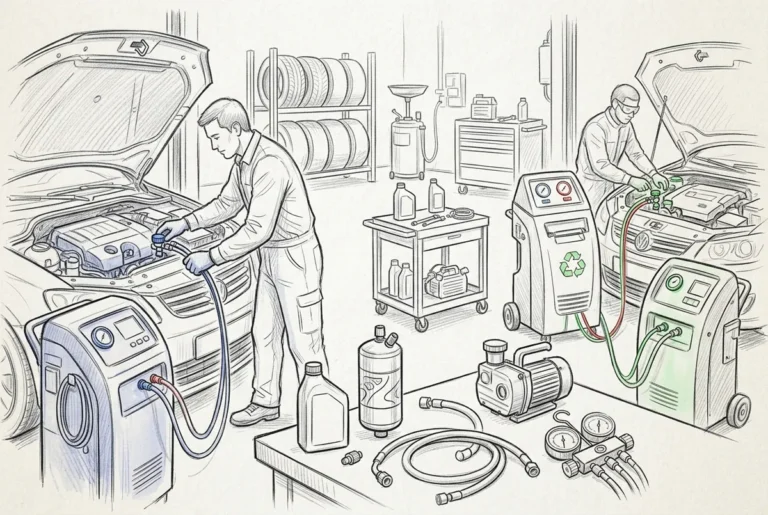
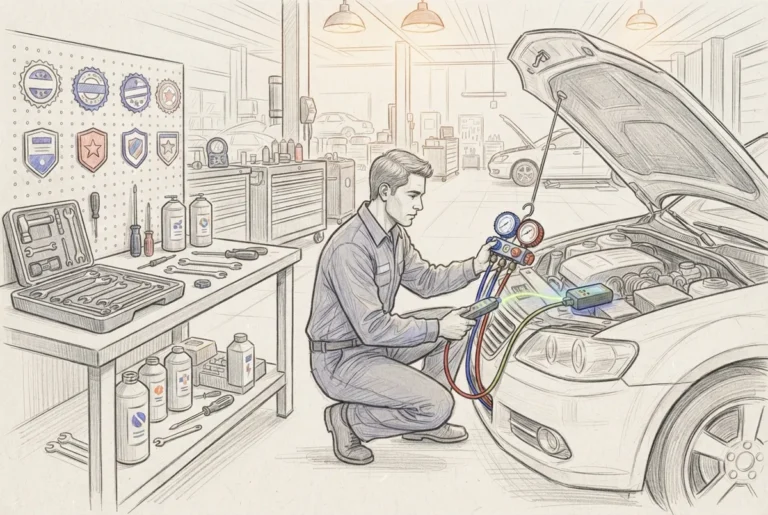
A real diagnosis starts with testing. A technician connects gauges to see how the system is behaving and checks whether key parts are doing their jobs.
Here is a quick look at what different findings can point to:
| What the Tech Finds | What It Often Means |
|---|---|
| Low pressure on both sides | Low refrigerant, likely a leak |
| Compressor clutch not engaging | Electrical fault, low charge, or failed clutch |
| High pressure readings | Blocked condenser or weak cooling fans |
| Normal pressure, warm air | Control, blend door, or airflow issue |
This table is a general guide, not a final answer. Only testing confirms the real cause. At Marks Air, we inspect and test more than 25 points of your A/C system before recommending anything.
7. Find the Leak the Right Way
Guessing where a leak is can waste hours. Pros use approved leak-detection methods to find the exact spot, whether it is a hose, a seal, the condenser, the evaporator, or the compressor.
Finding the leak first means you only repair what is truly broken. If you drive a truck, our guide on how to detect AC leaks in your truck shows how early detection saves money. For more on this topic, check leak detection and repair facts for Tampa drivers.
8. Check the Compressor and Clutch
The compressor is the heart of your A/C. It moves refrigerant through the system, so when it fails, cooling stops fast.
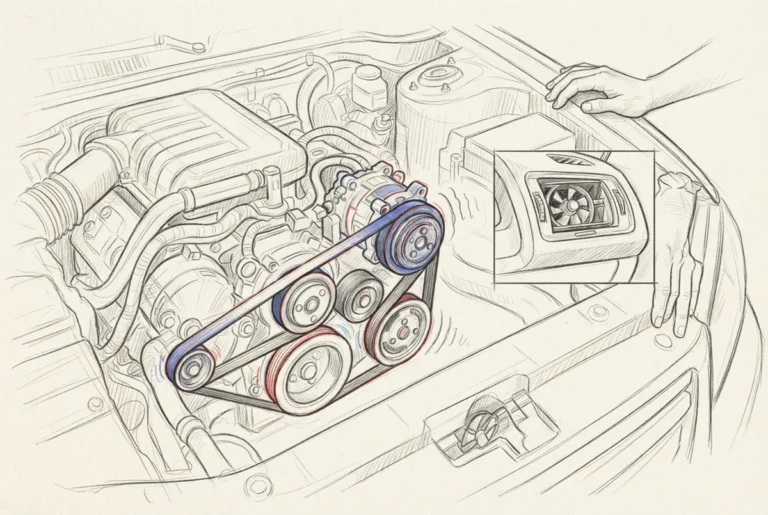
Warning signs include grinding or squealing noises, a clutch that will not engage, or air that stays warm even with a full charge. Sometimes the compressor can be repaired, and sometimes it needs replacement. Learn more in how to fix an AC compressor in your vehicle or see repair vs. replace to decide which path fits your budget.
9. Inspect the Condenser and Cooling Fans
The condenser sits at the front of your vehicle and releases heat from the refrigerant. If it is clogged with road debris, bent, or damaged, your A/C struggles, especially in stop-and-go Tampa traffic.
Weak or dead cooling fans cause the same trouble. Your A/C may blow cold on the highway but turn warm at red lights. That is a classic sign. If this sounds familiar, read signs you need AC condenser repair.
10. Repair the Actual Fault
Now comes the repair itself. A good shop replaces only what is needed, using the right parts for your vehicle. That might be a hose, a seal, a condenser, a blower motor, or a sensor.
The right parts matter. A mismatched part can fail early and put you right back where you started. Marks Air keeps a deep stock of parts, including our KOOL-TEMP line, and can source over 100,000 A/C parts when needed. You can browse our A/C parts to see what we carry.
11. Evacuate and Recharge With the Exact Refrigerant
After the repair, the system must be pulled into a deep vacuum. This removes air and moisture, which can cause corrosion and poor cooling. Then the system is recharged with the exact refrigerant type and amount your vehicle calls for.
This is a big one: R-134a and R-1234yf are not interchangeable. Mixing them or using the wrong one can damage the system and create safety risks. Check your under-hood label or service information first. Learn more about the shift in R-134a to 1234yf conversion.
For some perspective, EPA reports that R-134a has a global warming potential about 1,400 times that of CO₂, while HFO-1234yf has a GWP of just 4. Newer light-duty vehicles are moving toward the lower-impact option, though older vehicles can still be serviced with R-134a.
12. Skip the Risky Shortcuts
It is tempting to grab a cheap can from the store, but some shortcuts can cost you far more later. Here are the big ones to avoid:
- Propane or hydrocarbon refrigerants. EPA says these are not acceptable alternatives for car A/C systems. They can create real safety risks.
- Mixing refrigerants. It can contaminate the system and your shop’s equipment.
- Venting refrigerant. Releasing it on purpose during service is prohibited.
- Skipping the leak search. You will lose refrigerant again.
In the United States, anyone servicing car A/C systems for payment must hold EPA Section 609 certification and use approved recovery equipment. Marks Air is a proud member of the Mobile Air Climate Systems Association (MACS), so we stay current on industry standards. Techs who want to get certified can explore our training programs.
13. Re-Check and Verify the Fix
The last step is just as important as the first. A good shop tests the system again to confirm it cools properly, holds pressure, and runs safely.
At Marks Air, our technicians run the full 25-point checklist a second time before your vehicle goes back on the road. Most repairs are backed by a one-year warranty, so you can drive with peace of mind. Curious about the full flow? See our repair process or read what AC repair involves.
How Long Does It Take and What Does It Cost?
Every vehicle is different, so time and price depend on the cause. A simple airflow fix can be quick. A compressor or evaporator job takes longer. Parts availability also plays a role.
| Type of Fix | Typical Complexity |
|---|---|
| Cabin filter or fuse | Quick and simple |
| Leak repair and recharge | Moderate |
| Condenser or blower replacement | Moderate to involved |
| Compressor or evaporator work | Most involved |
Want real numbers? Our guides on auto AC repair cost and the cost to fix AC in a car give helpful ranges.
Tips for Trucks, Buses, RVs, and Fleets
Work vehicles face tougher demands than a daily commuter. Long hours, heavy loads, and constant heat all put extra stress on A/C systems. If you manage a fleet, a little planning keeps drivers comfortable and trucks on the road.
- Schedule regular inspections before summer hits.
- Fix small leaks early, before they become big failures.
- Keep common parts on hand to cut downtime.
- Train your techs on current refrigerants and safe handling.
Our articles on preventive vs. reactive fleet maintenance and fleet AC repair tips show how to save money over time.
Why Tampa Drivers Choose Marks Air
Marks Air is a family-owned, woman-owned business that has focused only on A/C since 1971. We work on cars, trucks, buses, RVs, emergency vehicles, and heavy equipment, all at our fully equipped Tampa shop. Because we only do A/C, we know the tricky stuff, and we avoid unnecessary repairs.
Don’t just take our word for it. See what our neighbors say on our reviews page, or read Marks Air reviews on Google. You can also learn more about our story on the About Marks Air page, or check our full list of A/C services.
Ready to Fix AC in Car Problems for Good?
To truly fix ac in car trouble, remember the main idea: find the cause, repair the fault, and recharge with the right refrigerant. Quick fixes feel nice for a moment, but a proper diagnosis keeps you cool all summer long. Start with the safe checks, skip risky shortcuts, and lean on a certified pro for anything involving refrigerant.
If your A/C is blowing warm, weak, or noisy, don’t sweat it. Schedule service with our friendly team, or call us at 813-988-1671 to talk it through. We’ll get you cool, verified, and back on the road.
FAQs
Q: Why is my car AC blowing warm air?
A: Warm air usually points to low refrigerant from a leak, a failed compressor or clutch, a blocked condenser, bad cooling fans, or an electrical fault. The only way to know for sure is to have the system tested, so you fix the real cause instead of guessing.
Q: Can I recharge my car AC myself, or should I take it to a shop?
A: We recommend leaving it to a pro. If your system is low, there is a leak, and a DIY can only hide that for a short time. Plus, the wrong refrigerant or too much of it can damage your system, so proper recovery, repair, and charging are best done by a certified technician.
Q: Can I use R-134a in a car that requires R-1234yf?
A: No, these refrigerants are not interchangeable. Using the wrong one or mixing them can damage the system and create safety risks. Always check your vehicle’s under-hood label or service information before any service.
Q: Is it safe to drive with a car AC refrigerant leak?
A: Most of the time you can still drive, but the A/C will slowly lose cooling power and the compressor can wear out faster without enough refrigerant and oil. Getting the leak found and fixed early usually costs less than waiting for a bigger failure.
Q: How long does a car AC repair take?
A: It depends on the problem. A simple filter or fuse fix can be quick, while leak repairs, condenser jobs, or compressor replacements take longer. Once we inspect your vehicle, we give you a clear estimate and timeframe before any work begins.
Our Service Area