Key Takeaways
-
Low refrigerant from a leak is the most common cause of warm car AC; refrigerant doesn't run out naturally, so a low charge always indicates a leak that must be found and repaired, not just topped off.
-
Pay attention to when warm air appears—cool at highway speed but warm at idle suggests condenser fan failure, while warm on one side only indicates a blend-door actuator problem.
-
Skip DIY refrigerant recharge cans and stop-leak products; they can overcharge the system, cause performance damage, clog passages, and mask the underlying leak that needs professional repair.
-
A proper AC repair requires five steps in order: repair the leak or failed part, recover old refrigerant, evacuate with a vacuum pump to remove air and moisture, recharge to exact specifications, and test performance.
-
Check your cabin air filter, listen for compressor clutch engagement, inspect the condenser for debris, and verify settings before calling a technician—these quick checks often reveal simple fixes.
-
A failing compressor, bad condenser fan, electrical faults like blown fuses, or a stuck blend-door actuator can all cause warm air and require professional diagnosis with proper gauges and leak detection tools.
There is nothing quite like the moment you crank up the A/C on a sticky Tampa afternoon and get a blast of warm air instead of a cool breeze. We have all been there, and it is no fun. The good news? A car ac blowing warm air fix is usually easier to find than you might think, once you know what to look for.
Warm air can come from a leak, a tired compressor, a fan that quit, a blown fuse, or even a stuck door inside your dash. Each one has its own clues. In this guide, we will walk through the most common causes, what you can safely check on your own, and how a pro finds the real problem.
Whether you drive a daily commuter, a delivery truck, a bus, an RV, or a piece of heavy equipment, the basics are much the same. Let’s get you back to feeling cool and comfortable.
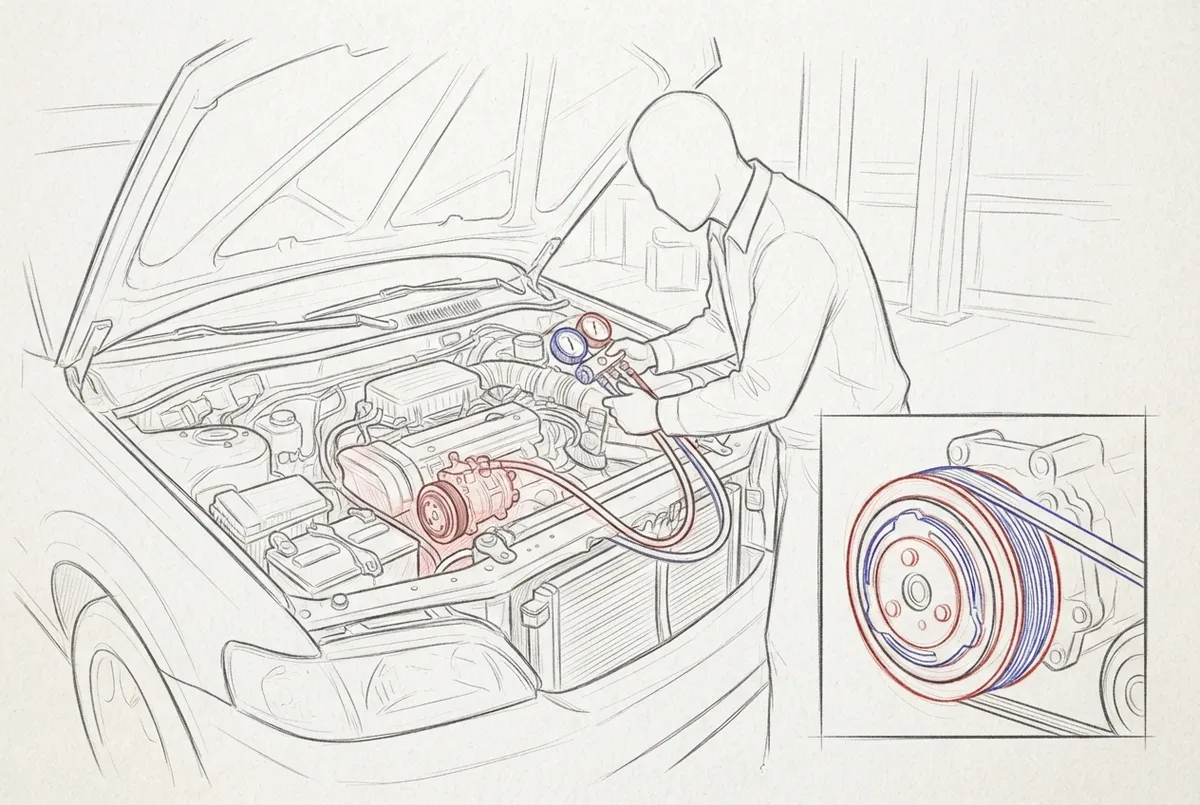
Why Is My Car AC Blowing Warm Air?
Your A/C does not make cold. It moves heat out of the cabin. Refrigerant carries that heat to the condenser at the front of the vehicle, where it is released into the air outside. If any part of that loop breaks down, the air from your vents turns warm.
The most common reasons include:
- Low refrigerant from a leak in a hose, seal, condenser, or evaporator
- A failing compressor or compressor clutch
- A bad condenser fan or a blocked condenser
- Electrical faults such as a blown fuse or bad relay
- A restricted expansion valve or orifice tube
- A stuck blend-door actuator inside the dash
Because so many parts can cause the same symptom, guessing rarely works. A quick look at the pattern of the problem helps narrow it down. For a deeper list, check out these 10 reasons your AC is blowing warm air and how to fix it.
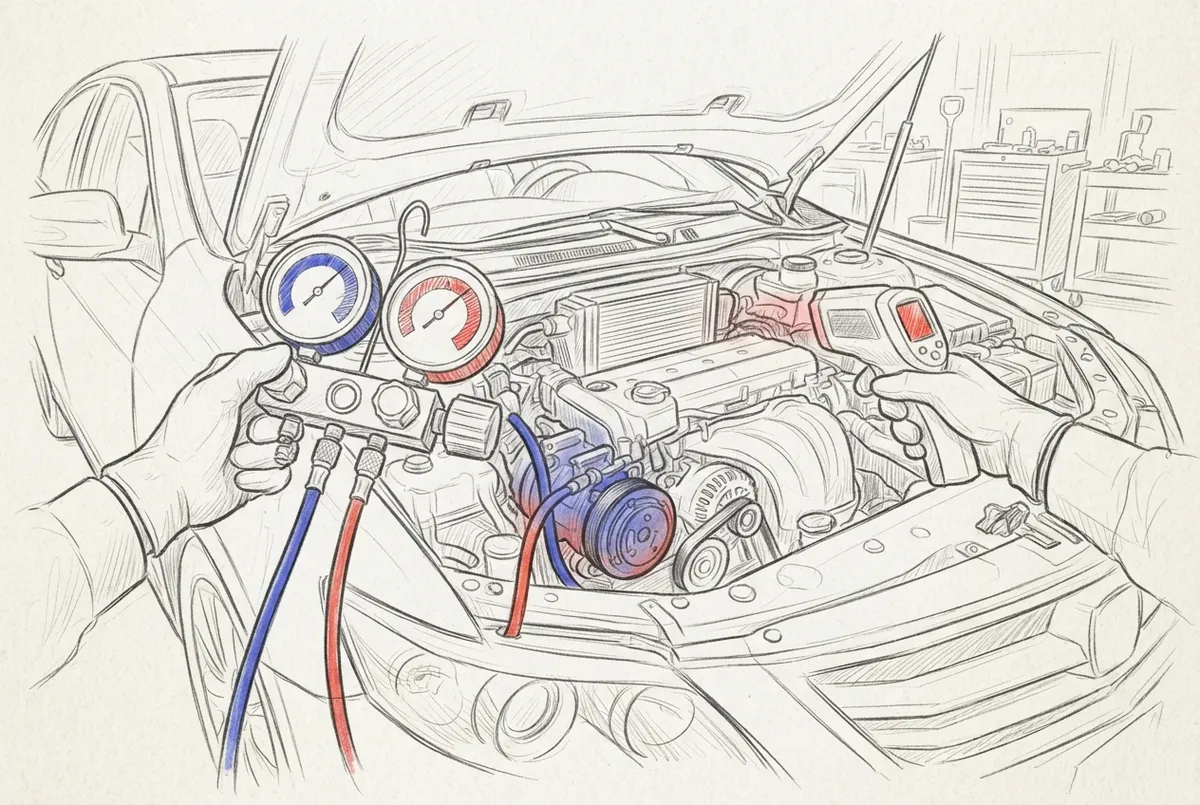
Read the Clues: What Your Symptoms Are Telling You
Your car often gives hints about what is wrong. Pay attention to when the warm air shows up and how the vents feel.
| What You Notice | Likely Cause |
|---|---|
| Cool at highway speed, warm at idle | Weak condenser airflow, such as a failed fan |
| Weak airflow from the vents | Clogged cabin air filter or blower motor issue |
| Strong airflow, but warm air | Low refrigerant, compressor, or temperature-control fault |
| Warm on one side, cool on the other | Blend-door actuator or low charge |
| Clutch never clicks on | Electrical fault, low pressure, or clutch failure |
| Cool at first, then turns warm | Freezing evaporator or a restriction |
These are guides, not final answers. Still, they give you and your technician a strong head start.
Cause 1: Low Refrigerant From a Leak
This is the big one. Many drivers think refrigerant “runs out” over time, like gas in a tank. It does not. A/C refrigerant is sealed in a closed loop and is not used up as you drive.
So if your system is low, there is a leak somewhere. It could be a worn hose, a dried-out seal, a rock-damaged condenser, or a leaky evaporator. Topping it off may cool things down for a bit, but the leak is still there and the cold will fade again.
The smart fix is to find the leak, repair it, and then recharge the system properly. Our post on how to detect AC leaks in your truck explains how leaks are found before they get worse. If you have ever wondered why the cold keeps fading, this look at why your car A/C won’t stop losing refrigerant can help too.
Cause 2: A Failing Compressor or Clutch
The compressor is the heart of your A/C. It pumps refrigerant through the system. If it wears out, or if the clutch that engages it fails, the refrigerant stops moving and the air stays warm.
Signs of trouble include:
- Grinding, squealing, or rattling noises when the A/C is on
- A clutch that does not spin when you press the A/C button
- Cooling that comes and goes
Sometimes only the clutch needs work. Other times the whole compressor needs replacing, and the system may need a flush if metal bits got into the lines. If you are weighing your options, see how to fix an AC compressor in your vehicle.
Cause 3: Condenser Fan or Condenser Problems
The condenser sits in front of the radiator. It needs good airflow to dump heat. When the condenser fan stops working, cooling often gets weak when you are stopped or in slow traffic, then improves once you are moving.
Bugs, leaves, road debris, and bent fins can also block the condenser. In Tampa’s stop-and-go traffic, this problem shows up fast. A condenser hit by road debris may also leak refrigerant.
If you drive a truck or bus, this part works even harder. Our guide to truck AC condenser replacement covers what the job involves.
Cause 4: Electrical Faults
Sometimes the A/C system is perfectly healthy, but it never turns on. A blown fuse, a bad relay, a faulty pressure switch, or a broken wire can keep the compressor from engaging.
This is one of the easier things to check. Look at your owner’s manual to find the A/C fuse and relay. A blown fuse is a clue, but it also means something caused it to blow. Swapping in a new fuse without finding the cause can lead to another failure.
Cause 5: Restricted Expansion Valve or Orifice Tube
The expansion valve or orifice tube controls how much refrigerant flows into the evaporator. If it clogs with debris or moisture, the flow drops and cooling suffers. You may notice frost on parts of the A/C lines, or cooling that starts strong and then dies off.
This kind of restriction often points to contamination inside the system. Fixing it usually means replacing the part, cleaning or replacing other components, and properly evacuating the system.
Cause 6: Blend-Door Actuator Trouble
Inside your dash, a small door mixes hot and cold air. An electric motor, called an actuator, moves it. If the actuator fails or the door gets stuck, hot air from the heater core can leak in, even when the A/C is working fine.
Common signs are clicking noises behind the dash and temperatures that will not change when you turn the dial. This is a cabin control issue, not a refrigerant one, so adding refrigerant will not help.
What Can You Safely Check Yourself?
A few quick checks can save you time. None of these need special tools or refrigerant handling.
- Check your settings. Make sure the A/C is on, the temperature is set to cold, and the fan is running.
- Feel the airflow. Weak airflow points to a dirty cabin air filter or a blower problem.
- Replace the cabin air filter if it is dirty or has not been changed in a while.
- Look at the front of the vehicle. Check the condenser for leaves, bugs, or bent fins.
- Watch the condenser fan. With the A/C on and the engine running, it should spin.
- Listen for the click. You should hear the compressor clutch engage when the A/C turns on.
- Check the fuse. Use your owner’s manual to find and inspect the A/C fuse.
If all of that looks fine and the air is still warm, it is time for a professional look. You can also read our vehicle AC troubleshooting guide for more ideas.
Why You Should Skip DIY Recharge Cans and Stop-Leak
It is tempting to grab a can of refrigerant at the parts store. We understand. But this shortcut often backfires.
- You cannot tell if the system is low without proper gauges and context.
- Overcharging can hurt cooling and damage the compressor.
- Mixing refrigerants can cause performance problems.
- Stop-leak products can clog small passages and make later repairs harder.
- A leak that stays unrepaired will just drain the system again.
A single low-side pressure reading also cannot spot every fault. Pressures have to be read in context with temperature, airflow, and system type. We share more on this in our post about AC leak mistakes that cost car owners more money.
How Pros Diagnose a Car AC Blowing Warm Air
A good technician does not just add refrigerant and hope. They follow a clear process to find the real cause.
- Verify the complaint. They confirm your control settings and how the system behaves.
- Check airflow and electrical operation. Fans, clutch, fuses, relays, and switches all get tested.
- Measure refrigerant pressures. Gauges show how the high and low sides are working together.
- Test for leaks. Tools like electronic detectors or UV dye help pinpoint where refrigerant escapes.
- Inspect key parts. Hoses, condenser, compressor, and expansion device get a close look.
You can learn more about what to expect from car AC diagnostic costs in 2026.
What a Proper Refrigerant Repair Looks Like
Once the cause is found, the fix follows a set order. Skipping steps leads to weak cooling and early failures.
- Repair the leak or replace the failed part.
- Recover the refrigerant using approved recovery equipment.
- Evacuate the system with a vacuum pump to remove air and moisture.
- Recharge with the correct refrigerant and the exact amount your vehicle maker specifies.
- Test performance to confirm cold air at the vents.
Moisture and air inside a system cause poor cooling and can damage parts from the inside. That is why the vacuum step matters so much.
Newer vehicles may use HFO-1234yf instead of R-134a, and the two are not interchangeable. If you are curious about the switch, see our guide on R-134a to 1234yf conversion.
Why Certification Matters
In the United States, anyone servicing motor vehicle A/C systems for pay must hold EPA Section 609 certification and use approved refrigerant-handling equipment. The EPA also requires refrigerant to be recovered before service when a release could reasonably be expected. This protects the environment and makes sure the work is done correctly.
Marks Air is a proud member of the Mobile Air Climate Systems Association (MACS), and the team also teaches EPA 609 and related courses. You can see what that looks like on our training page.
How Much Does It Cost to Fix Warm Air?
Costs vary a lot because the cause varies a lot. Vehicle type, refrigerant type, parts, and labor all play a part. Here are some sample figures reported in 2022 to give you a rough idea.
| Service | Reported Range | Source |
|---|---|---|
| A/C recharge (average) | $285–$369 | RepairPal, cited by ConsumerAffairs |
| Leak inspection | $122–$179 | RepairPal, cited by ConsumerAffairs |
| Standard A/C service visit with recharge and leak check | $430–$521 | ConsumerAffairs sample quotes |
| Compressor replacement | $1,319–$2,515 | ConsumerAffairs sample quotes |
These are not universal prices, and 2026 quotes may differ. Larger vehicles like buses, RVs, and heavy equipment can cost more. For a closer look, read how much auto AC repair costs in 2026.
Tips for Trucks, Buses, RVs, Fleets, and Heavy Equipment
Bigger systems follow the same basic rules, but downtime hurts more. A warm cab wears down drivers and operators, and a hot bus makes for unhappy riders. Here are a few tips that help:
- Schedule regular checks before summer, not after a breakdown.
- Keep condensers clean if you work in dusty or dirty conditions.
- Use quality parts that fit your make and model.
- Track service records across your whole fleet to spot repeat problems.
Fleet managers may find our post on preventive vs. reactive fleet AC maintenance helpful. If you rely on quality components, browse our A/C parts selection.
When to Call a Pro in Tampa
If the quick checks do not solve it, do not wait. A small leak or a weak fan can turn into a bigger, pricier repair if ignored. In Tampa’s heat, a working A/C is not a luxury. It is a comfort and safety matter.
Marks Air has focused on vehicle and heavy equipment air conditioning in Tampa since 1971. As a family-owned, woman-owned shop, we handle diagnostics, leak detection, hose fabrication, repairs, installations, and parts, all under one roof. You can learn more about our A/C services or read what customers say on our Marks Air Google listing.
Conclusion: Get Back to Cool, Comfortable Rides
A car ac blowing warm air fix starts with finding the real cause, not just adding refrigerant. Leaks, compressor trouble, fan issues, electrical faults, restrictions, and blend-door problems can all lead to warm air, and each one needs the right repair. A proper job means fixing the fault, recovering the old refrigerant, pulling a vacuum, and recharging to the exact spec.
If your A/C is not keeping up, we are happy to help. Schedule service with Marks Air or call us at 813-988-1671 and let’s get your vehicle blowing cold again.
FAQs
Q: Why is my car AC blowing warm air?
A: The most common reason is low refrigerant caused by a leak, but a bad compressor, a failed condenser fan, an electrical fault, or a stuck blend door can do it too. The best move is to have a technician find the cause rather than just adding refrigerant.
Q: Does car AC refrigerant run out, or does a low charge mean there is a leak?
A: Refrigerant is not used up as you drive, since it stays sealed in a closed loop. If your system is low, that almost always points to a leak that should be found and repaired.
Q: Why does my car AC get cold while driving but warm at idle?
A: This pattern often points to weak airflow across the condenser, such as a failed condenser fan or a blocked condenser. At road speed, moving air helps cool the condenser, but at idle it cannot shed heat well.
Q: Can I just add a recharge can to fix warm air?
A: It is best to skip it. Without proper gauges you cannot tell if the system is truly low, and overcharging or using stop-leak products can hurt performance and cause damage. A pro will fix the leak and recharge to the exact amount your vehicle needs.
Q: How much does it cost to fix a car AC that blows warm air?
A: It depends on the cause. Reported 2022 estimates ranged from about $285 to $369 for a recharge and about $1,319 to $2,515 for a compressor replacement, though your quote may differ by vehicle, parts, and labor.