
Key Takeaways
-
A recharge may restore cold air temporarily, but automotive A/C is a sealed system, so low refrigerant almost always means a leak that needs to be found and fixed.
-
Look for EPA Section 609 certified technicians, recent customer reviews, and equipment matched to your vehicle's refrigerant (R-134a or R-1234yf) before booking.
-
Request a written estimate that lists diagnosis, parts, labor, and refrigerant separately, and ask whether the diagnostic fee applies toward the repair.
-
Warm or uneven air, weak airflow, squealing or grinding noises, musty smells, and oily residue on hoses or fittings are early warning signs worth checking promptly.
-
Ask about warranty coverage for both parts and labor, since a reputable shop should stand behind its repairs.
-
Run your A/C for a few minutes weekly, replace the cabin filter on schedule, and keep the front condenser clear of debris to prevent costly failures.
Few things ruin a summer drive faster than warm air blowing from your vents. In Tampa, where the heat sits heavy for months, a broken car A/C isn’t just annoying. It can make a commute miserable and a long haul feel endless. If you’ve typed “ac repair near me” into your phone while sweating behind the wheel, you’re in the right place.
Here’s the good news: finding the right shop doesn’t have to be stressful. With a little know-how, you can spot the signs of trouble, ask smart questions, and pick a shop that fixes the real problem the first time. This guide walks you through the whole process in plain English. Whether you drive a daily commuter, a delivery truck, a bus, an RV, or heavy equipment, you’ll learn what to look for and what to expect. Let’s get you back to cool, comfortable driving.

What “AC Repair Near Me” Really Means for Your Vehicle
When you search for ac repair near me, you want a nearby shop that can figure out why your vehicle isn’t cooling. That’s different from a quick top-off of refrigerant. A good auto A/C shop inspects the whole system and fixes the root cause.
Typical services include:
- System inspection and pressure testing
- Leak detection
- Refrigerant recovery and recharge
- Repair or replacement of the compressor, condenser, evaporator, hoses, or expansion valve
- Final performance checks after the repair
Automotive A/C is a sealed system. That means refrigerant isn’t supposed to run low over time. If yours does, there’s almost always a leak somewhere. A recharge might bring back cold air for a while, but it won’t fix the leak. That’s why the best shops start with a diagnosis. For a deeper look at this, see our guide on AC leak mistakes that cost car owners more money.

Signs Your Vehicle Needs A/C Repair
Your A/C usually gives you hints before it quits completely. Catching them early can save you money. Watch for these common warning signs:
- Warm or uneven air: Cold on one side, warm on the other, or just not cold enough.
- Weak airflow: The fan is running, but barely any air comes out.
- Strange noises: Squealing, grinding, or rattling when the A/C kicks on.
- Musty smells: A damp, locker-room odor from the vents.
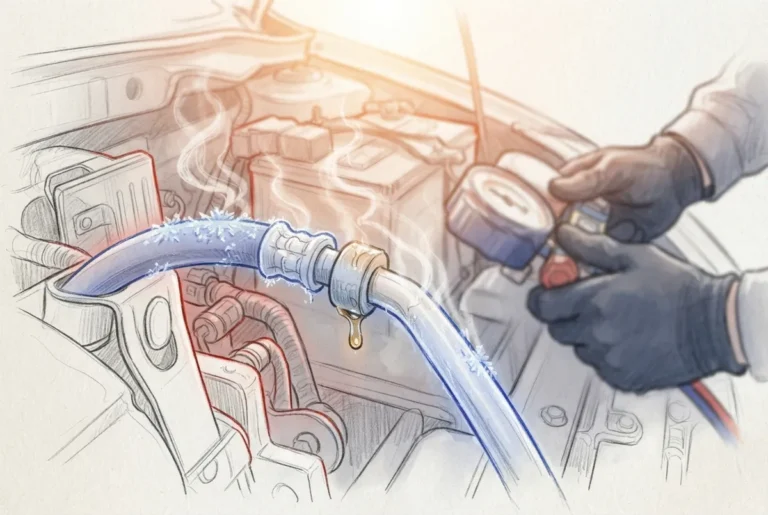
- Oily residue: Greasy spots on hoses or fittings can point to a refrigerant leak.
These symptoms can come from different problems, so don’t guess. A proper diagnosis tells you what’s actually wrong. If you want to dig into causes, our post on 10 reasons your AC is blowing warm air is a helpful read. You can also review 5 signs you need car AC repair near me before you book.
Step-by-Step: How to Find the Right Auto A/C Shop
Ready to start your search? Follow these steps and you’ll narrow things down quickly.
- Search with specifics. Add your vehicle type, such as “truck,” “bus,” or “RV,” to your search so you find shops that work on what you drive.
- Check reviews. Look at recent customer feedback on Google, Yelp, and Facebook. Patterns matter more than a single comment.
- Confirm certification. Ask if technicians hold EPA Section 609 certification.
- Ask about your refrigerant. Make sure the shop has the right equipment for your vehicle.
- Request a written estimate. Get diagnosis, parts, labor, and refrigerant listed separately.
- Ask about the warranty. Learn what’s covered on both parts and labor.
- Compare and decide. Choose the shop that explains things clearly and treats you with respect.
Want more tips on picking a trustworthy shop? Our guide to finding the best AC repair in Tampa for your vehicle goes into even more detail.
Why Certification and Refrigerant Type Matter
This part sounds technical, but it’s really about protecting your wallet and the environment. In the United States, anyone who services motor-vehicle A/C systems for pay must hold EPA Section 609 certification. They must also use approved equipment to recover refrigerant. Intentionally venting refrigerant into the air is not allowed.
Refrigerant type matters, too. Many older vehicles use R-134a, while many newer ones use R-1234yf. Your vehicle is built for one of them, and you shouldn’t swap casually. R-1234yf also needs compatible service equipment, so a shop must be properly set up to handle it. If you’re curious about the newer refrigerant, check out HFO-1234yf refrigerant for fleets and 12 things to know about R-134a to 1234yf conversion.
A reputable shop is also plugged into the industry. For example, Marks Air is a member of the Mobile Air Climate Systems Association (MACS), which helps keep its team current on standards and best practices.
What Happens During a Proper A/C Service Visit
Knowing what to expect takes the mystery out of the visit. A good shop follows a clear process. At Marks Air, that process is called the 25-Point Cool Check, and it looks like this:
- Schedule and drop off. Book an appointment and bring your vehicle in.
- Inspect. The team tests more than 25 points of your A/C system.
- Recommend and estimate. You get a clear recommendation, a written estimate, and a timeframe. No work starts until you approve.
- Repair. Only what’s needed gets replaced, using the right parts.
- Re-check. The technician runs the full checklist again to confirm everything works.
- Back on the road. Your A/C is cool, verified, and backed by a one-year warranty on most repairs.
That kind of transparency is exactly what you want. You see what’s wrong, you approve the plan, and you drive away with proof the job was done right. To learn more about the steps involved, read 6 steps that show what AC repair involves.
How Much Does Car A/C Repair Cost in 2026?
Cost is usually the first question on everyone’s mind. The honest answer is that it varies a lot. The price depends on your vehicle, the refrigerant it uses, your location, and what’s actually broken. Here’s a quick look at national estimates to help you set expectations:
| Service | Typical National Estimate |
|---|---|
| Standard A/C service with recharge and leak inspection | $430 to $521 (average quotes) |
| A/C recharge | About $285 to $369 |
| Leak inspection | About $122 to $179 |
| Pressure-switch replacement | About $350 to $400 |
| Cabin-filter replacement | About $100 |
| Compressor replacement | Can exceed $2,000 |
These figures come from national sources reported by ConsumerAffairs in 2026, and they aren’t guaranteed local prices. Your real cost depends on a proper diagnosis. That’s why a written, itemized estimate is so important. For a closer look, see how much auto AC repair costs in 2026 and 5 key factors that determine AC compressor replacement cost.
Questions to Ask Before You Hand Over Your Keys
A little preparation goes a long way. Before you commit to any shop, ask these questions:
- Is there a separate diagnostic fee, and does it apply toward the repair?
- Does the estimate include leak testing and refrigerant?
- What warranty covers parts and labor?
- Do you have equipment for my vehicle’s refrigerant?
- Can I get the estimate in writing, with each charge listed?
A confident, honest shop will answer these without hesitation. If someone dodges your questions, that’s your cue to keep looking. You can also avoid common pitfalls by reading 10 auto AC repair mistakes that cost you more money.
Repair Needs for Different Vehicle Types
Not every vehicle has the same needs, and the right shop understands that. Here’s a quick breakdown of what different owners often face:
- Cars: Leaks, worn compressors, and clogged condensers are common in stop-and-go Tampa traffic.
- Trucks and fleets: Downtime costs money, so fast diagnostics and parts availability matter most. See 4 fleet vehicle AC repair tips that save you money.
- Buses and transit: Passenger comfort and safety depend on steady, reliable cooling.
- RVs: Systems can be less common, so you want a shop with real troubleshooting experience.
- Heavy equipment: Operators need cool cabs to avoid fatigue in hot outdoor work.
Marks Air has focused only on A/C systems since 1971, serving Tampa drivers and operators of cars, trucks, buses, RVs, emergency vehicles, and heavy equipment. That specialization means the team has seen nearly every kind of A/C problem. If you’re curious about the shop’s story, visit About Marks Air, or see what real customers say on the reviews page and by visiting Marks Air on Google.
Need a Part? Here’s How to Get It Fast
Sometimes you just need the right part. Maybe you’re a technician, a fleet manager, or a do-it-yourselfer. A good A/C shop should be able to help you find it, even without a part number.
At Marks Air, the parts process is simple:
- Tell the team what you need by call, text, or email. A part number, vehicle details, or even a photo works.
- Specialists identify the part, even with no number.
- They find it from shelf stock or from over 100,000 A/C parts they can source.
- You pick it up at the counter or have it shipped.
Many items are available the same day. You can browse the A/C parts page to see what’s offered, including the fire truck compressor from the KOOL-TEMP line. For help knowing where to start, try 15 AC parts near me that keep your vehicle cool.
Simple Habits That Keep Your A/C Healthy
The best repair is the one you never need. A few easy habits can extend the life of your system:
- Run the A/C for a few minutes every week, even in cooler weather, to keep seals lubricated.
- Replace your cabin filter on schedule so airflow stays strong.
- Keep the condenser at the front of the vehicle free of bugs and debris.
- Pay attention to new noises or smells and get them checked early.
Small steps like these catch problems before they turn into big bills. For more ideas, read 5 AC maintenance tips every Tampa vehicle owner needs.
And while your vehicle gets some TLC, why not treat yourself, too? If you’re looking to relax after a sweaty week, Mobile Area Massage of Tampa Bay brings the spa experience right to you. You can also follow the Marks Air community on Facebook for updates and tips.
Is It Safe to Drive With a Broken A/C?
Usually, yes. A broken A/C itself won’t stop your car from running. But there are some cautions. If the compressor is seizing or making loud grinding noises, it can damage the belt that also drives other parts. A fogged windshield you can’t clear is also a safety concern, since the A/C helps dry the air. And in Tampa’s heat, driving without cooling can lead to fatigue or heat stress, especially for long hauls or heavy equipment work. When in doubt, get it looked at soon.
Ready to Cool Down? Let’s Get You Taken Care Of
Finding great ac repair near me doesn’t have to feel like a gamble. Look for a certified shop, ask for a clear written estimate, and choose a team that explains the problem before touching your vehicle. Fix the root cause, not just the symptom, and you’ll enjoy cold air for the long haul.
Marks Air has been helping Tampa drivers stay cool since 1971, and our family-owned, woman-owned team would love to help you, too. Schedule service today, or call us at 813-988-1671 to talk through what your vehicle needs. Stay cool out there!
FAQs
Q: Why is my car’s A/C blowing warm air?
A: Warm air usually points to low refrigerant from a leak, a failing compressor, a clogged condenser, or an electrical problem. Because the causes vary, a proper diagnosis is the best way to find the real issue before you spend money on repairs.
Q: Does my car need an A/C recharge or a leak repair?
A: Car A/C is a sealed system, so low refrigerant almost always means there’s a leak. A recharge may bring back cold air for a while, but fixing the leak is what keeps it cold. Ask your shop to check for leaks and explain the recommended fix.
Q: What is the difference between R-134a and R-1234yf?
A: These are two types of refrigerant. Many older vehicles use R-134a, while many newer ones use R-1234yf. Your vehicle is designed for one type, and R-1234yf needs compatible service equipment, so don’t swap them casually.
Q: How can I choose a reliable auto A/C repair shop nearby?
A: Look for recent customer reviews, EPA Section 609 certified technicians, and a written estimate that separates diagnosis, parts, labor, and refrigerant. Also ask about warranty coverage and whether the shop has the right equipment for your vehicle’s refrigerant.
Our Service Area