
Key Takeaways
-
A good A/C shop finds out why your system stopped cooling instead of just adding refrigerant, since a recharge alone is usually a short-term fix if a leak is still present.
-
Your A/C is a sealed loop that doesn't use up refrigerant, so low levels almost always mean a leak or a past service problem that needs to be located and repaired.
-
Ask whether the shop services your vehicle's specific refrigerant type (R-134a or HFO-1234yf), since the two should never be mixed or swapped casually.
-
Confirm that technicians hold EPA Section 609 certification, which is required for paid A/C service, and that refrigerant is recovered and recycled rather than released into the air.
-
Insist on a written estimate and timeframe before any work begins, and ask for the warranty details on both parts and labor in plain language.
-
Early warning signs like weak airflow, musty odors, oily residue on fittings, or grinding noises should be checked promptly, since a failing compressor can spread debris and make repairs costlier.
It’s a hot Tampa afternoon. You hop in your car, crank the A/C, and get… a lukewarm sigh. We have all been there, and it is no fun. So you grab your phone and type in car air conditioner repair service near me, hoping to find someone you can trust.
Here’s the good news: finding the right shop is easier when you know what to look for. A good A/C shop does more than add refrigerant. It finds out why your system stopped cooling, explains the problem in plain words, and fixes it so it lasts.
In this friendly guide, we’ll walk you through the warning signs, what a real A/C diagnosis includes, the rules that protect you and the environment, and the questions to ask before you hand over your keys. Whether you drive a car, a truck, a bus, an RV, or heavy equipment, you’ll leave ready to pick the right shop with confidence.

What Does a Car Air Conditioner Repair Service Actually Do?
A car A/C repair service diagnoses and fixes the system that cools your cabin. That system has several moving parts, and any one of them can cause trouble. A good technician checks the whole system, not just one piece.
Here are the main parts that may need attention:
- Compressor: the heart of the system, which pumps refrigerant through the loop.
- Condenser: sits near the front of the vehicle and releases heat.
- Evaporator: sits inside the dash and cools the air you feel.
- Expansion valve or orifice tube: controls how refrigerant flows.
- Hoses, seals, and fittings: carry refrigerant and are common leak points.
- Blower motor and electrical controls: move the air and tell the system when to run.
Want a closer look at these parts? Our guide to 6 A/C parts every vehicle owner should know in 2026 breaks them down in simple terms.

Why Is My Car A/C Not Cooling? Common Warning Signs
Your A/C usually gives you hints before it quits completely. Catching them early can save you money and stress. Watch for these signs:
- Warm or off-and-on cool air. The air starts cold, then fades, or never gets cold at all.
- Weak airflow. The fan is running, but very little air comes out of the vents.
- Strange noises. Rattling, grinding, or squealing when the A/C is on can point to a compressor or belt issue.
- Bad smells. A musty or sour odor often means moisture or buildup in the system.
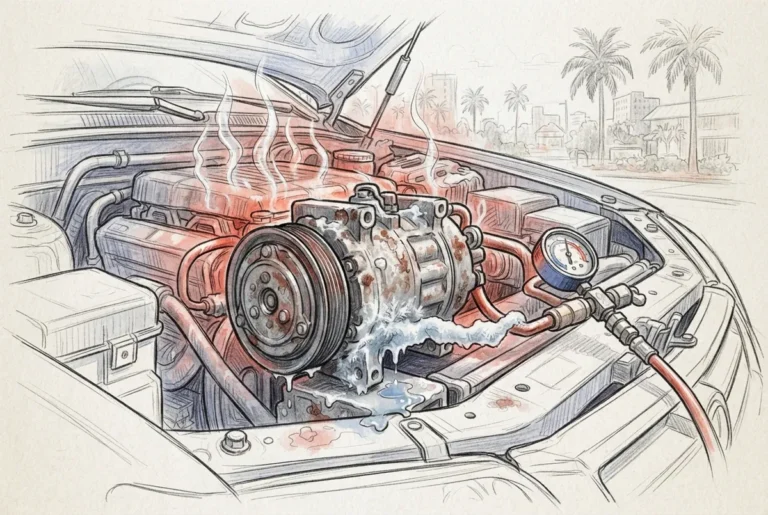
- Oily residue. A greasy film on hoses or fittings can mean refrigerant is leaking.
- Cooling that gets worse at idle. If it cools better while driving than at a stoplight, airflow or fan problems may be to blame.
Keep in mind that many of these symptoms have more than one possible cause. That’s why a quick recharge doesn’t always fix things. For a deeper look, check out 10 reasons your A/C is blowing warm air.
Recharge or Repair? Why Refrigerant Leaks Matter
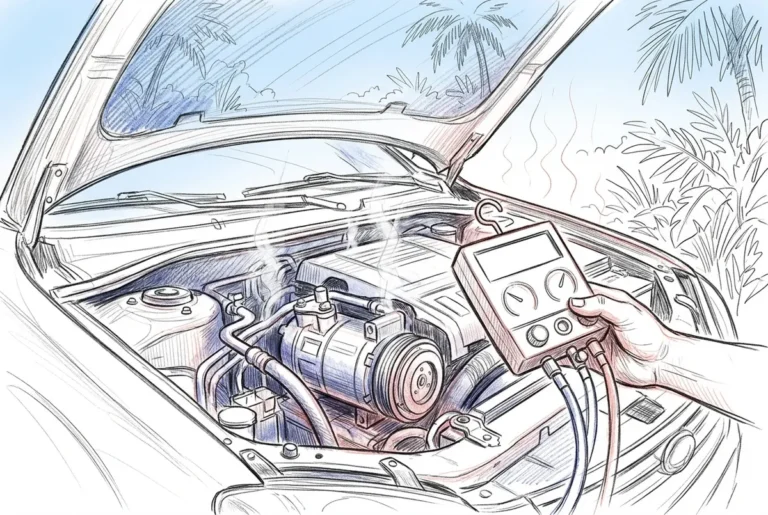
Here’s something many drivers don’t know: your A/C does not use up refrigerant like your engine uses oil. It runs in a sealed loop. So if the level is low, something is usually leaking or went wrong during a past service.
Topping off the system might bring back cold air for a few weeks. But if the leak is still there, the cold air will fade again. You’ve spent money and the problem is still waiting for you.
A smart shop will find the leak first. Then it will explain whether you need a small fix, like a new O-ring or hose, or a bigger repair. Only after the repair should the system be properly evacuated and recharged to the right amount.
Curious about the most common mistakes here? Take a peek at 13 A/C leak mistakes that cost car owners more money.
What Happens During a Professional A/C Inspection?
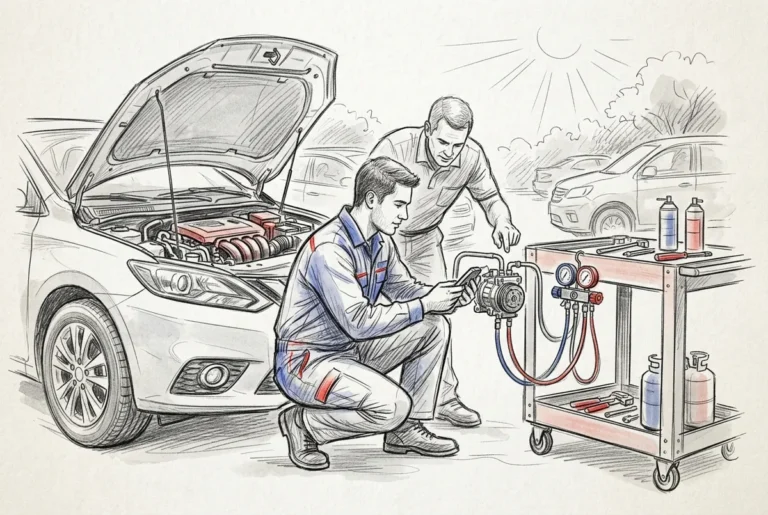
Every vehicle is a little different, but a solid diagnostic visit usually covers several steps. Knowing them helps you spot a shop that does things the right way.
Typical Diagnostic Steps
- Check the symptoms. The technician asks when the problem started and how it behaves.
- Measure vent temperature. This shows how well the system is actually cooling.
- Test system pressures. Gauge readings give clues about refrigerant level and component health.
- Inspect belts, fans, and wiring. Electrical and airflow problems are easy to miss.
- Check compressor operation. The tech makes sure the clutch engages and the compressor runs properly.
- Test for leaks. Specialized tools help find where refrigerant is escaping.
At Marks Air, our 25-Point Cool Check follows a clear path. We inspect and test more than 25 points of your A/C system, give you a written estimate and timeframe, and do no work until you approve. After the repair, we run the full checklist again to make sure everything is working. Most repairs are backed by a one-year warranty.
Want to understand the costs of diagnosis? Read 3 key facts about car A/C diagnostic cost in 2026.
What Does Car A/C Repair Cost?
This is the question everyone asks, and the honest answer is: it depends. Prices change based on your vehicle, the type of refrigerant, the cause of the problem, the parts needed, and the labor involved. Anyone who promises one flat price before looking at your car may not be giving you the full picture.
Here is a simple look at what usually affects the final bill:
| Factor | Why It Affects Price |
|---|---|
| Vehicle type | Cars, trucks, buses, RVs, and heavy equipment have different systems and part costs. |
| Refrigerant type | Newer HFO-1234yf systems often cost more to service than older R-134a systems. |
| Cause of failure | A small leak costs less to fix than a failed compressor or evaporator. |
| Parts needed | Quality, availability, and brand can change the price. |
| Labor time | Some parts, like an evaporator behind the dash, take much longer to reach. |
| Diagnosis | Finding the true cause takes skill and time, but prevents repeat repairs. |
The best protection is a clear, written estimate before any work begins. For more detail, see how much auto A/C repair costs in 2026.
R-134a or HFO-1234yf: Which Refrigerant Does Your Car Use?
Not all cars use the same refrigerant. Many older vehicles use R-134a. Many newer vehicles use HFO-1234yf. The right type and service method depend on your specific vehicle, and the two should never be mixed or swapped casually.
Why does this matter? The fittings, equipment, and procedures can differ. Using the wrong refrigerant can hurt performance and can even cause damage. Your vehicle usually has a label under the hood that tells you which refrigerant it uses. A good shop will check it before touching your system.
If you’re curious about the switch, here are 12 things to know about R-134a to 1234yf conversion. Fleet owners may also like HFO-1234yf refrigerant for fleets.
EPA Rules That Protect You and the Environment
In the United States, the rules for car A/C service are strict, and for good reason. According to the EPA, technicians who service motor vehicle A/C systems for pay must hold Section 609 certification and use approved refrigerant-handling equipment.
The rules also say that refrigerant must be recovered, not released into the air. Recovered refrigerant has to be recycled or reclaimed before it is used again, even if it goes back into the same vehicle. This matters because R-134a has a global warming potential about 1,400 times that of carbon dioxide, according to the EPA.
So when you ask a shop about their certifications, you’re not being picky. You’re making sure your car is handled the right way. Marks Air is also a member of the Mobile Air Climate Systems Association (MACS), which helps us stay current with industry standards. If you work in the trade, you can learn more about our EPA 609 and A/C training programs.
How to Choose a Good Car A/C Repair Shop Near You
With so many choices, how do you pick? Start with this simple checklist. A trustworthy shop will happily answer every one of these questions.
- Do you service my vehicle’s refrigerant type? The answer should be a clear yes or no.
- Do you perform a real leak diagnosis? Avoid shops that only offer a quick top-off.
- Will I get a written estimate before work starts? You should always approve the price first.
- What warranty do you offer on parts and labor? Ask for the details in plain language.
- Are your technicians EPA Section 609 certified? This is required for paid A/C service.
- Can you work on my kind of vehicle? Trucks, buses, RVs, hybrids, and heavy equipment can need special know-how.
It also helps to read what real customers say. You can read Marks Air reviews, check our listing on Yelp, or see what neighbors say when you visit our Marks Air location on Google. For more tips, our guide on how to find reliable car air conditioner repair near me goes even deeper.
Why Specialization Makes a Difference
Plenty of shops fix brakes, oil, and tires. But A/C systems are a world of their own. A shop that focuses on air conditioning sees the same problems over and over, so it can spot trouble faster and avoid repairs you don’t need.
Marks Air is a family-owned, woman-owned business that has served Tampa since 1971. We focus only on A/C systems for cars, trucks, buses, RVs, emergency vehicles, and heavy equipment. Our fully equipped Tampa facility handles diagnostics, leak detection, hose fabrication, repairs, installations, and custom systems all under one roof.
We also keep a deep stock of parts, including our KOOL-TEMP line and trusted brands, with many items available the same day. Need a part and don’t have the part number? Just send us a photo and our specialists will identify it. Learn more about Marks Air and our story.
Special Notes for Trucks, Buses, RVs, and Fleets
Not every A/C problem shows up in a family sedan. Different vehicles have different needs, and downtime costs real money.
- Truck drivers and fleets: A broken A/C hurts driver comfort and focus. Preventive care keeps trucks on the road. See 4 fleet vehicle A/C repair tips that save you money.
- Bus and transit operators: Passengers expect cool, comfortable rides in Tampa’s climate. Learn what proper bus A/C system maintenance involves.
- RV owners: RV cooling systems can be less common and harder to troubleshoot, so expert help matters.
- Heavy equipment operators: Cool operators stay alert and safe. Here’s how to get heavy equipment A/C repair done right.
Can You Keep Driving With a Broken A/C?
In many cases, yes, you can still drive. But it isn’t always a good idea to wait. If the compressor is making loud grinding noises, it could fail and spread debris through the system, which makes the repair bigger and costlier. A belt problem can also affect other parts of your engine.
In Tampa’s heat, a car without A/C can be uncomfortable and even unsafe for kids, pets, and older passengers. If you notice trouble, it’s best to get it checked early. If it feels urgent, read about emergency A/C repair in Tampa.
Simple Habits That Help Your A/C Last Longer
A little care goes a long way. Try these easy habits:
- Run your A/C for a few minutes every week, even in cooler months, to keep seals moving.
- Replace the cabin air filter on schedule to protect airflow.
- Park in the shade when you can to reduce heat stress.
- Get a quick inspection before summer starts.
- Fix small leaks early, before they turn into big repairs.
Want more? Here are 5 A/C maintenance tips every Tampa vehicle owner needs.
Ready to Get Your Cool Back?
Finding the right car air conditioner repair service near me doesn’t have to feel overwhelming. Look for a shop that finds the real cause, explains it clearly, follows EPA rules, gives you a written estimate, and stands behind its work. When you find that, hold on to it.
At Marks Air, we’ve been keeping Tampa drivers cool since 1971. Ready to feel that cold air again? Schedule service with our team or call us at 813-988-1671. We would love to help you get back on the road, cool and comfortable.
FAQs
Q: Why is my car air conditioner blowing warm air?
A: Warm air can come from a refrigerant leak, a compressor or clutch problem, an electrical fault, or a blocked airflow path. Because there are many possible causes, it’s best to have a technician test the system instead of guessing.
Q: Should I recharge my car A/C or repair a leak?
A: If your system is low on refrigerant, there is usually a leak, so a recharge alone is a short-term fix at best. A good shop will find and repair the leak first, then properly evacuate and recharge the system.
Q: How do mechanics find a refrigerant leak in a car?
A: Technicians use specialized leak-detection tools and pressure tests, and they inspect hoses, seals, and fittings for oily residue. The exact method depends on your vehicle and refrigerant system.
Q: How long does a car A/C repair or recharge take?
A: Simple services can be quick, while jobs like replacing an evaporator or compressor take longer because of parts access and labor. A good shop will give you a written estimate and timeframe before starting.
Q: What should I ask before choosing a car A/C repair shop?
A: Ask whether they service your refrigerant type, perform real leak diagnosis, provide a written estimate, offer a warranty, and use EPA Section 609 certified technicians. Clear, friendly answers to these questions are a great sign.
Our Service Area