
Key Takeaways
-
A proper A/C visit should diagnose why the system isn't cooling, not just add refrigerant, since a recharge without finding the cause often leads to the cool air fading again.
-
Refrigerant loss usually means a leak, so ask whether the quote includes leak testing and repair rather than only a recharge.
-
In the U.S., anyone servicing a vehicle A/C for pay must hold EPA Section 609 certification and use approved refrigerant-handling equipment, so ask for proof.
-
Get a written estimate that separates the diagnostic fee, leak testing, refrigerant type and amount, parts, labor hours, and taxes before approving any work.
-
Confirm the shop services your vehicle's refrigerant type (R-134a or R-1234yf), since these systems are not interchangeable.
It happens to almost everyone. You hop in your car on a hot Tampa afternoon, turn the A/C to max, and get a blast of warm, sticky air. Suddenly, your drive feels about ten miles longer. If that sounds familiar, you have probably typed automotive air conditioning service near me into your phone more than once.
Here is the good news. Finding the right shop is easier when you know what a good service visit looks like. It is not just about adding refrigerant and sending you on your way. A real service finds out why your system is not cooling and fixes the cause.
This friendly guide shares 14 things every driver should know before booking. Whether you drive a car, a work truck, a bus, an RV, or heavy equipment, these tips will help you pick a shop with confidence and avoid wasted money. Let’s get you cool again.

1. Good Service Means Diagnosis, Not Just a Recharge
When you search for automotive air conditioning service near me, you want a shop that finds the real problem. A quick recharge may feel good for a week. But if something else is wrong, the cool air will fade again.
A proper visit should answer one simple question: why is my A/C not cooling? The shop should test the system, explain what it found, and recommend repairs based on those results. Our guide on how to get automotive air conditioning service right goes even deeper on this.

2. Know the Common Warning Signs
Your A/C usually gives hints before it quits. Watch for these signs:
- Warm or weak airflow from the vents
- Cooling that comes and goes
- Strange noises when the A/C is on
- Musty or unpleasant smells
- Visible oily residue or signs of a leak
Keep in mind that these symptoms can have many causes. They do not prove that refrigerant is low. That is why testing matters. If you notice any of these, our list of signs you need car A/C repair can help you decide when to act.
3. Ask What the Diagnosis Includes
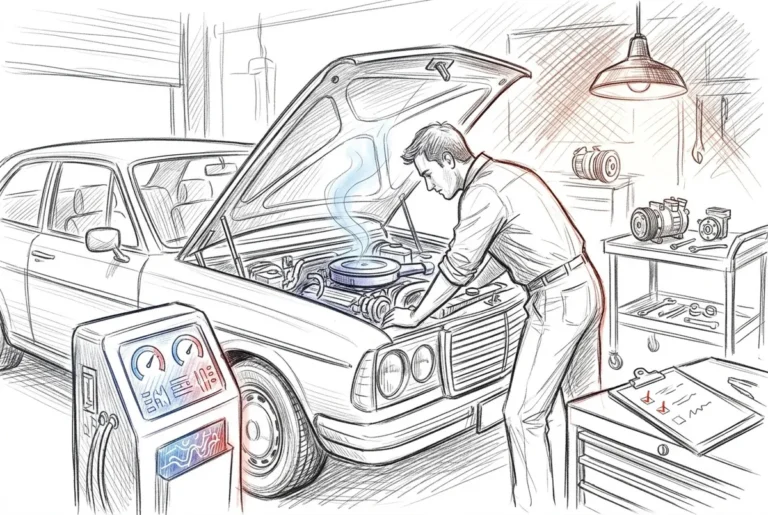
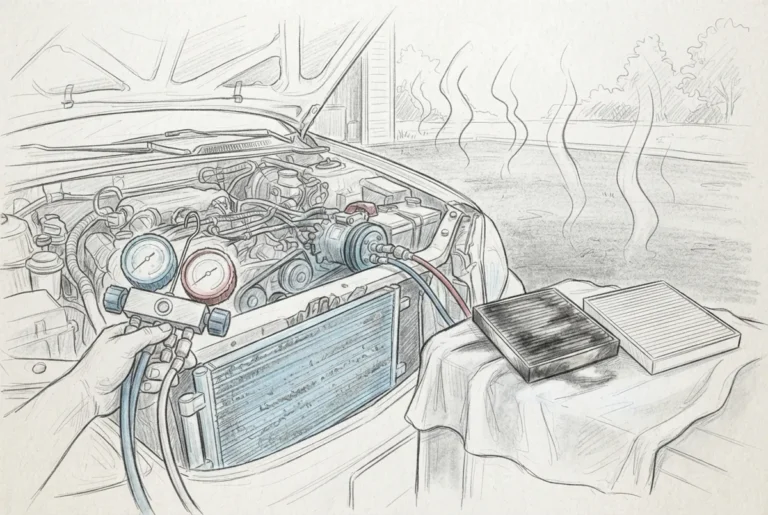
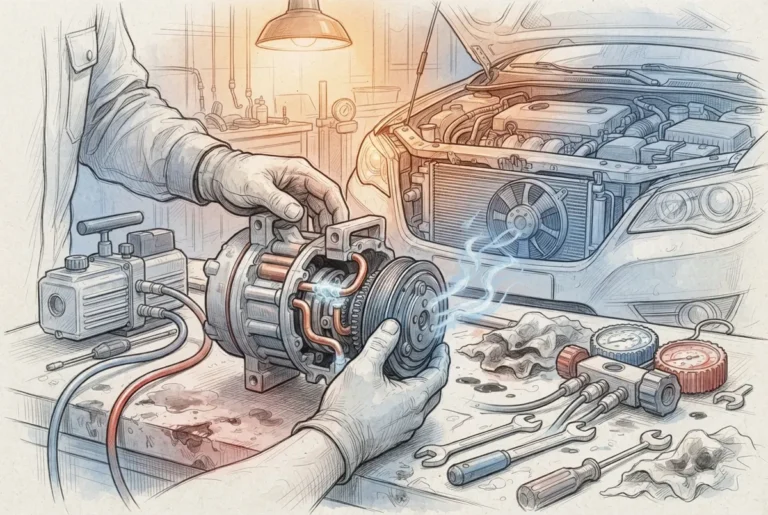
A good diagnostic is more than a quick glance. Depending on your vehicle, a shop may check vent temperature, test system pressures, and look over belts, hoses, and electrical controls. They may also inspect the cooling fans and the compressor, and test for leaks.
Not every vehicle needs the exact same steps. But you should always be able to ask, “What did you test?” and get a clear answer.
4. Low Refrigerant Often Means a Leak
Here is something many drivers do not realize. Your A/C is a sealed system. It should not lose refrigerant over time like gas in a tank. So if the level is low, a leak may be the reason.
Adding more refrigerant without finding the leak is like filling a tire with a nail in it. Ask the shop if the quote covers leak testing and repair, or only a recharge. For more on this topic, see our article on leak detection and repair.
5. Not All Refrigerants Are the Same
Vehicles use different refrigerants. Many older cars use HFC-134a, while many newer models use HFO-1234yf. The correct type and charge amount depend on your specific vehicle.
These refrigerants and the service equipment that handles them should not be treated as interchangeable. Always ask whether the shop services your vehicle’s refrigerant type. You can learn more in our guide to R-134a to 1234yf conversion.
6. Check for EPA Section 609 Certification
Here is a big one for trust. In the United States, anyone who services a motor vehicle A/C system for pay must hold EPA Section 609 certification. They must also use approved refrigerant-handling equipment.
Venting refrigerant on purpose is not allowed. Recovered refrigerant must be recycled or reclaimed before it is reused. Shops must also keep records, and EPA guidance says certain records must be kept for 3 years. A shop that follows these rules is showing you it takes the work seriously.
7. Look for Real Experience
Experience counts, especially with A/C. Systems have many parts that work together, and small mistakes can cause big problems later.
Marks Air is a family-owned, woman-owned shop that has served Tampa since 1971. We focus only on air conditioning systems for vehicles and heavy equipment. That focus helps us find problems faster and avoid repairs you do not need. We are also proud to be a member of the Mobile Air Climate Systems Association (MACS).
8. Ask for a Clear Written Estimate
Nobody likes surprise bills. Before any work begins, ask for a written estimate. It should help you tell apart the diagnostic fee and the actual repair cost.
Here is a quick table of what a clear estimate should list:
| Estimate Item | What to Ask |
|---|---|
| Diagnosis | Is the fee separate, or applied to the repair? |
| Leak testing | Is it included in the quote? |
| Refrigerant | Which type, and how much? |
| Parts | Which parts, and from which brands? |
| Labor | How many hours are quoted? |
| Taxes and fees | Are they listed up front? |
If you are wondering about price ranges, remember that costs vary by vehicle, refrigerant, parts, and labor rates. We break it down in how much auto A/C repair costs.
9. Find Out About the Warranty
A repair is only as good as the promise behind it. Ask if the work is covered by a warranty and what that warranty includes. A shop that stands behind its repairs is usually confident in its work.
At Marks Air, most repairs are backed by a 1-year warranty. You can also read what our customers say on our reviews page.
10. Understand the Typical Service Process
A smooth visit follows a clear path. Here is what it can look like when done right:
- Schedule and drop off. Book an appointment and bring the vehicle in.
- Inspect. The technician tests many points of your A/C system.
- Recommend and estimate. You get a clear recommendation, a written estimate, and a timeframe.
- Approve. No work begins until you say yes.
- Repair. Only what is needed gets replaced, using the right parts.
- Re-check. The technician tests the system again to verify the fix.
That last step matters. A re-check proves the repair worked before you drive away. Our own proven process includes a 25+ point check at both the start and the end.
11. Fleets and Work Vehicles Need Special Care
If you run a truck fleet, a bus line, or heavy equipment, downtime costs money. A broken A/C also hurts driver comfort and focus on long, hot shifts.
Look for a shop that works on commercial vehicles, not just passenger cars. Ask about hose fabrication, same-day parts, and custom systems. Our tips on fleet vehicle A/C repair can help you save time and money. We also work on RVs, emergency vehicles, and agricultural equipment.
12. Parts Availability Can Speed Everything Up
Waiting days for one small part is frustrating. A shop with a deep parts inventory can often finish repairs faster.
Marks Air stocks a full line of A/C parts, including our KOOL-TEMP line and trusted industry brands, with many items available the same day. We can source over 100,000 A/C parts. If you are a technician or a DIYer, browse our A/C parts selection. No part number? Send us a photo and we will help identify it.
13. Compare Shops With the Right Questions
When you compare nearby shops, a few smart questions can tell you a lot. Here is a handy checklist:
| Question | Why It Matters |
|---|---|
| Are your technicians EPA 609 certified? | It is required for paid A/C service |
| Do you service my vehicle’s refrigerant type? | Systems are not interchangeable |
| Does the quote include leak testing? | Prevents repeat problems |
| Is the repair warrantied? | Protects your investment |
| Will you explain the diagnosis? | Shows honesty and clarity |
You can also check online feedback. Look at the shop’s profile on Yelp and see what our Marks Air customers say on Google. For more tips, read how to find the best car A/C service near me.
14. Do Not Wait Until It Fully Quits
Small A/C problems tend to grow. A tiny leak can turn into a damaged compressor if you keep running a low system. That can turn a modest repair into a costly one.
Regular checkups help you catch trouble early, especially before Tampa’s hottest months. If you are unsure whether to repair or replace a part, our guide on repair versus replacement can point you in the right direction. And if your A/C failure feels urgent, see our tips on emergency A/C repair in Tampa.
Need a quick health check on your own health too during those hot days? If you ever feel overheated while waiting on repairs, a visit to InCare for urgent care can be a helpful backup plan.
Ready for Cold Air Again?
Finding the right automotive air conditioning service near me does not have to be stressful. Look for a shop that diagnoses first, explains clearly, follows EPA rules, and stands behind its work. Those simple steps protect your wallet and keep you comfortable on the road.
At Marks Air, we have been keeping Tampa vehicles cool since 1971. Whether you drive a car, truck, bus, RV, or heavy equipment, our team is ready to help. Schedule service with Marks Air today, or call us at 813-988-1671 to talk with a real A/C specialist. You can also follow us on Facebook for news and tips. Stay cool out there!
FAQs
Q: Where can I get my car’s air conditioning checked near me?
A: Look for a local shop that specializes in A/C systems and offers a full diagnosis, not just a recharge. At Marks Air in Tampa, we test the system, give you a written estimate, and only start work after you approve it. You can schedule service online or call 813-988-1671.
Q: Why is my car’s air conditioner blowing warm air?
A: There are many possible causes, like a refrigerant leak, a failing compressor, a bad fan, or an electrical issue. Warm air alone does not prove refrigerant is low, so a proper diagnosis is the best way to find the real cause.
Q: Does low refrigerant mean my car has an A/C leak?
A: Often, yes. A car’s A/C is a sealed system, so it should not lose refrigerant over time. If the level is low, ask your shop to test for leaks instead of just adding more refrigerant.
Q: How can I tell whether a shop is qualified to service my car’s A/C?
A: In the United States, anyone servicing a vehicle A/C for pay must hold EPA Section 609 certification and use approved refrigerant-handling equipment. Ask about certification, your vehicle’s refrigerant type, and whether the repair comes with a warranty.
Q: Does my vehicle use R-134a or R-1234yf refrigerant?
A: It depends on your vehicle’s make, model, and year. The correct refrigerant type and charge amount are vehicle-specific, so check your owner’s manual or ask your A/C shop to confirm before any service.
Our Service Area